I have been voting for the Fielding Bible Awards since 2012 and this is the first time I’ve tried to articulate why I voted the way I did. I wish I’d done this in 2012. My process was a lot more extensive back then, but with experience I’ve gradually scaled it back to something more reasonable without taking away from the legitimacy of the selections.
Admittedly, my current process is heavily Defensive Runs Saved reliant. That’ll be obvious when you see the choices. I also scrutinize something else we track, Good Plays and Defensive Misplays data.
We chart roughly 30 types of Good Fielding Plays (such as keeping the ball on infield or cutting it off in the outfield to prevent a batter or runner from taking an extra base) and 60 types of Defensive Misplays (such as failing to complete a double play or overthrowing a cutoff man). I look not just for a high number of Good Plays, but a good ratio of good plays to misplays & errors relative to others at the position.
Lastly, I do use MLB’s Fielding Run Value (FRV); that’s more reflected in my second- through fifth-place votes. You’ll see for instance at second base and shortstop, I went with the Runs Saved leader over the FRV leader.
Catcher
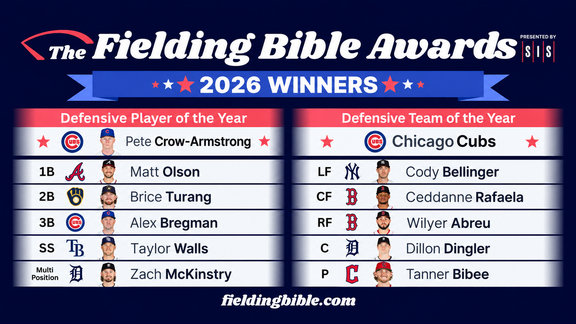
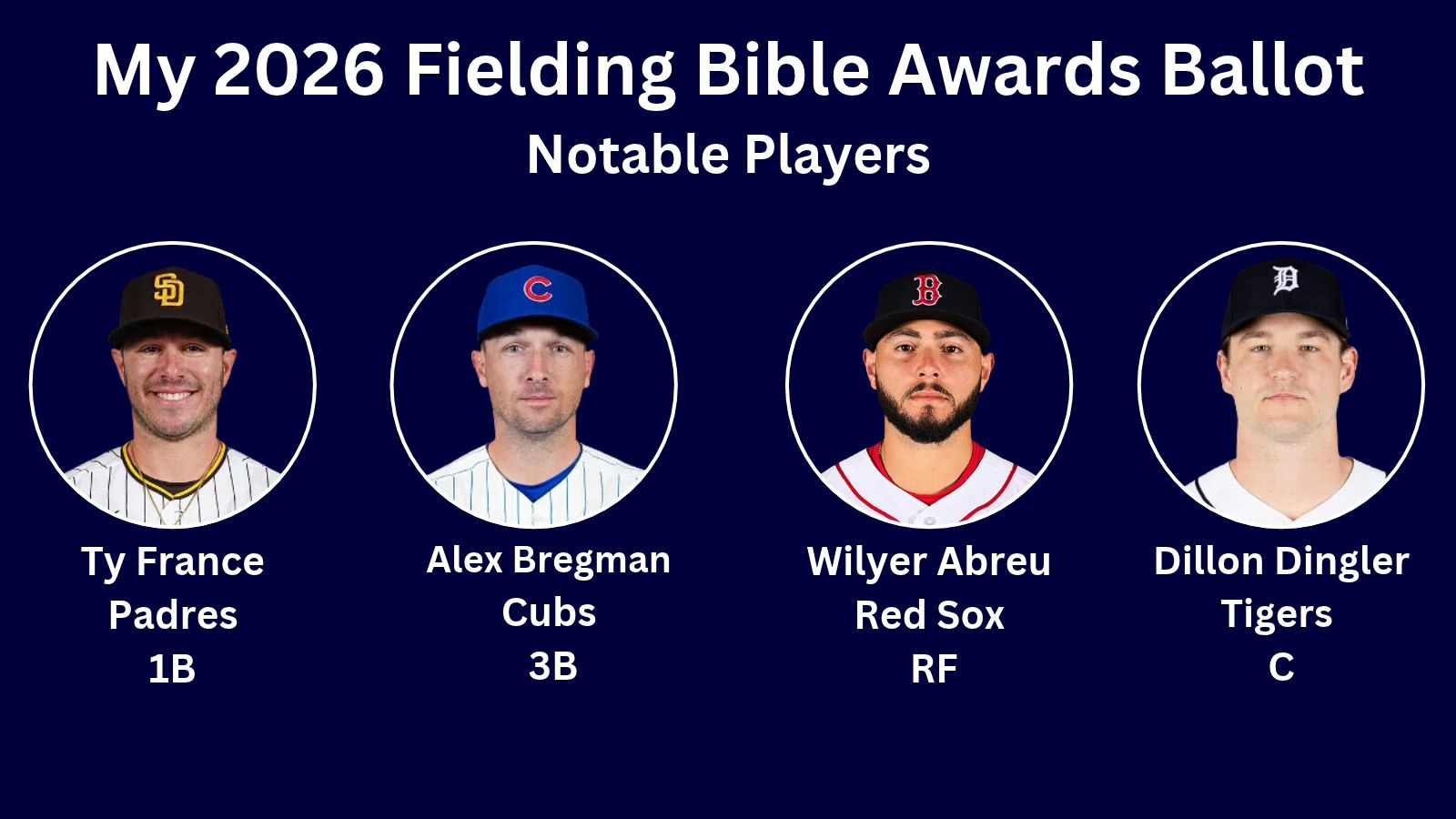
- Dillon Dingler (winner)
- Luis Torrens
- Gabriel Moreno
- Joe Mack
- Henry Davis
This was a tight race all season and one of the ones I followed the closest. When I’m voting for catcher, I prioritize our pitch framing, pitch blocking, and stolen base defense stats more so than our “staff handling” proxy (Adjusted Earned Runs Saved) and fielding batted balls.
Dingler got the most runs from framing, virtually tied for the most from blocking and was as good or better than Gabriel Moreno and Luis Torrens in stolen bases. I went Torrens over Moreno for second because of his edge over Moreno in the three stats I value most.
First Base
- Ty France
- Matt Olson (winner)
- Vladimir Guerrero Jr.
- T.J. Rumfield
- Vinnie Pasquantino
This was a two-man race between Matt Olson and Ty France, and it was hard not to vote for Olson because I feel like I’ve never seen him make a defensive mistake. I value both range and throw-handling here. France rated better in both the range component and throwing components of Defensive Runs Saved and the throw handling component of Fielding Run Value.
A four-run edge for France in Defensive Runs Saved in one season of data isn’t necessarily definitive but it is notable. I’m not going to begrudge anyone who voted for Olson, he’s great. It’s a toss-up and my toss went to France.
Second Base
- Brice Turang (winner)
- Cole Young
- Brandon Lowe
- JJ Wetherholt
- Nasim Nunez
This one wasn’t hard. I like second basemen who cover a lot of ground. Brice Turang was the only second baseman who was +10 or better in Plays Saved (our version of Outs Above Average) going both to his left and his right. Turang halved his Defensive Misplays and Errors from last season and improved his double play conversion percentage. As such, he was our runaway leader in Runs Saved among second basemen.
I know that Turang was behind JJ Wetherholt in MLB’s metrics, but I’m going to put my faith in our numbers. I voted Wetherholt 4th and I know I could have listed him higher. Young had the edge in Runs Saved and I rewarded him for being at or near the top of the leaderboard from the earliest part of the season. I voted Brandon Lowe ahead of Wetherholt even though the two finished tied in Runs Saved because of Lowe’s one-year turnaround. He went from -14 Runs Saved in 2025 to 13 in 2026. I felt like that improvement should be rewarded.
Third Base
- Alex Bregman (winner)
- Caleb Durbin
- Matt Chapman
- Maikel Garcia
- Junior Caminero
Alex Bregman and Matt Chapman finished tied in Defensive Runs Saved. However, Bregman played 143 games and Chapman played 83. I will typically reward the player who got through the grind of a full season over the smaller-sample star even if the small-sample player has a great Runs Saved per-game rate.
I also put Caleb Durbin (13 Runs Saved in 151 games) ahead of Chapman as I particularly like that Durbin didn’t even know what position he was going to play at the start of the season but played great when put in that spot.
If you’re wondering why Junior Caminero is fifth, I’m again rewarding the Runs Saved improvement (see second base and Brandon Lowe). Caminero went from -5 to 5 Runs Saved in the span of a year. I used to vote in a small-college basketball Top 25 poll and would sometimes use my last spot to salute improvement or an underrecognized team. That’s what I’m doing here.
Shortstop
- Taylor Walls (winner)
- Masyn Winn
- Bobby Witt Jr.
- José Caballero
- Mookie Betts
Adam Berry wrote a piece for Rays.com earlier this year about Walls’ adjustments to his pre-pitch positioning and that perhaps explaining the frequent difference between Defensive Runs Saved (which has Walls’ as the No. 1 shortstop over the last six years) and Fielding Run Value (which rates him below-average).
I consider Walls’ ‘as-the-pitch-comes-in’ adjustments part of his value, so I didn’t hesitate at all to vote for him as this year’s winner. They’re movements he’s making independent of his team so he should get credit for them as part of his value. He’s +17 plays saved to his left and +9 to his right and there’s no other shortstop that can match that combination. Walls was well ahead of the field in Defensive Runs Saved. Masyn Winn was very good in both Runs Saved and FRV and is a worthy runner-up (he’s previously won a Fielding Bible Award).
One note here: José Caballero finished second in Runs Saved but played only 70 games at shortstop, so I voted him fourth behind two full-season standouts in Winn and Bobby Witt Jr. I have a feeling that Witt will win the AL Gold Glove based on his reputation, but I hope it was a close vote.
Left Field
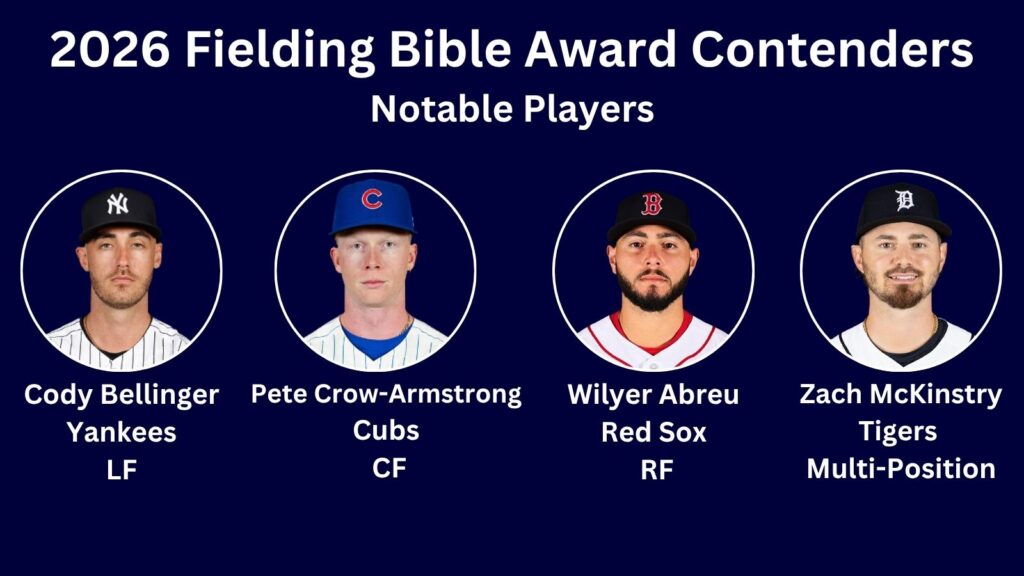
- Cody Bellinger (winner)
- Jackson Chourio
- Ian Happ
- Daylen Lile
- Chandler Simpson
I happen to think that so long as Bellinger is healthy he’s overqualified to play left field 81 times a year at Yankee Stadium. He showed it between the balls he caught and the throws he made. He averaged 93 MPH on the top 10% of his throws per Baseball Savant, best of any left fielder. He should probably be playing right field. This didn’t feel like a hard choice.
I was impressed with Jackson Chourio visually (including his postseason work, which didn’t factor in) but Bellinger’s statistical body of work was overwhelming. The Chourio-Ian Happ decision in left field was probably a tough one for Gold Glove voters.
Center Field
- Ceddanne Rafaela (winner)
- Pete Crow-Armstrong
- Andy Pages
- Michael Harris II
- Garrett Mitchell
I spent a good amount of time over the last three months parsing this one out (and wrote about it at Baseball Prospectus). I landed on Rafaela ahead of Crow-Armstrong because I wanted the center fielder with the best combination of results from their range and their arm. Crow-Armstrong has the best range numbers but Rafaela got better overall results from the two combined. The two of them had the same number of Misplays & Errors, but PCA had ones that were more costly in value.
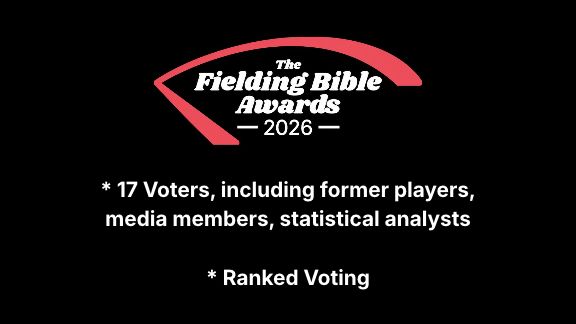
If you’re reading this and you disagree, I’m unbothered. I don’t think there’s a right answer here and the fact that 17 voters gave them the same number of first-, second-, and third-place votes makes me think that whatever take I have is a reasonable one.
Right Field
- Wilyer Abreu (winner)
- Seiya Suzuki
- Corbin Carroll
- Nathan Lukes
- Carson Benge
The gap between Abreu and the No. 2 right fielder in Defensive Runs Saved is bigger than the gap at any other position. He had 28 Runs Saved. Seiya Suzuki had 14. That by itself made this a pretty easy vote.
Though other outfielders measure up with Abreu on range, the separator is Abreu’s arm. His top 10% best throws average 95 MPH, which is top five among right fielders. Only 40.5% of baserunners advanced against him when the opportunity was there, the third-lowest rate in MLB, and he threw out 13, the most of any right fielder in MLB (9 without the aid of a cutoff man). That feels like good enough justification for me.
Pitcher
- Shota Imanaga
- Tanner Bibee (winner)
- Brent Suter
- Michael McGreevy
- Foster Griffin
Pitcher always feels impossible for me to figure out. I came really close to voting Brent Suter No. 1 after watching every play he made during the season. But in the end I decided I wanted a starting pitcher. Sitting here a couple weeks later, there’s a part of me thinking I should have done so but I felt someone with more innings pitched deserved it.
In the end, I went with Imanaga over Bibee. Though both had 5 Runs Saved, tied for second-most behind Suter, Imanaga had one more pickoff (5 vs 4) and no errors or Defensive Misplays, and Bibee had 3.
Multi-Position
- Zach McKinstry (winner)
- José Caballero
- Steven Kwan
- Nasim Nuñez
- Daniel Schneeman
Zach McKinstry made this easy by putting up great numbers in right field in August and September and sharing Defensive Player of the Month honors in both months. McKinstry had well-established his versatility already. His play in right field (particularly the 5 Outfield Arm Runs Saved) gave him the combination of excellence and versatility that couldn’t be beat.
In 2024 I voted for Daulton Varsho for this Award, so there was a precedent for me voting for Steven Kwan with a similar positional breakdown. But the difference between Varsho and Kwan is that Varsho led all players in Runs Saved that year while Kwan was fifth among outfielders in 2026. I slotted José Caballero ahead of Kwan to reward Caballero for the same reason as McKinstry, excellence at shortstop and all-around versatile skill. I feel a little bad that Kwan comes out of this year with nothing because he’s so good.
Player of the Year
- Ceddanne Rafaela
- Brice Turang
- Wilyer Abreu
I imagine I’m going to get roasted for this one, but I couldn’t justify listing PCA No. 1 if I wasn’t going to put him No. 1 in center field. In the end, I considered five players and if I considered how I felt about them on a scale of 1 to 100, it looked something like this.
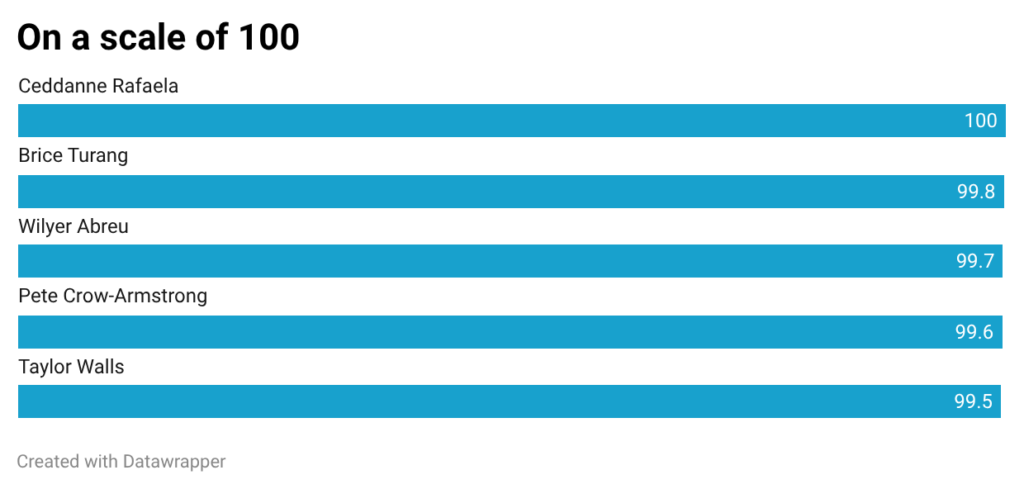
In other words, I could have gone with any one of them. They’re all great defensive players. What pushed Rafaela over the top for me was my being impressed that he could lead center fielders in Defensive Runs Saved two years in a row in this era.
I can combine that with having been told about how physically taxing playing center field is and also having heard about the challenges of playing center field in Fenway Park, whereas former major leaguer Doug Glanville told me “Fenway is crazy. Right center is a lot to cover with the low wall and the garage door behind you that presents strange metallic bounces. Then to your right is the pinball machine posing as the left center field remnant of the Green Monster, angled to go towards the Bermuda Triangle. It’s a fun unorthodox challenge where you have to have a materials science degree with a concentration in ballistics and ricochets.”
Not to discount the challenge of playing center field anywhere else (Wrigley is certainly complicated too), but I was fine with my Rafaela pick after reading that from Doug.
Team of the Year
- Chicago Cubs (winner)
- Atlanta Braves
- Boston Red Sox
This was the easiest No. 1 on the ballot. The Cubs were an outstanding defensive team across the board this year as reflected in just about every stat. They would have led MLB in Defensive Runs Saved even if you replaced Crow-Armstrong with a center fielder who had -10 Runs Saved. They could win Gold Gloves at all three outfield positions this year. They have past Fielding Bible Award winners at both middle infield positions.
I decided to vote the Braves and Red Sox ahead of the Rays, who were No. 2 in Runs Saved, because I wanted to reward the skills of the players on those teams over the value of the team’s positioning. The Braves had a very strong defense at just about every position. Like the Cubs, they had a negative Runs Saved at only one position (catcher). I rewarded the Red Sox for their incredible defensive outfield, which included two Fielding Bible Award winners.