Category: MLB

  • Stat of the Week: Year-End MLB Awards Part II

    Last week, we gave out some year-end MLB Awards to hitters, infielders, and outfielders. This week, we’re specifically rewarding the work of pitchers and catchers. Here are some honors that celebrate their outstanding performance.

    The Contact Minimizer

    The Contact Minimizer goes to the pitcher who limited hard contact best in 2018. The winner of that honor is Mets pitcher Noah Syndergaard.

    Of the batted balls hit against Syndergaard, only 21.9 percent were hard-hit. He was nearly three full percentage points ahead of the next-best starting pitcher, his teammate Zack Wheeler (24.8 percent). Both were better than Jacob deGrom, who placed fifth at 26.6 percent. Not surprisingly, Mets starting pitchers had the lowest hard-hit rate in the majors last season (29 percent).

    Among relief pitchers with at least 50 innings pitched in 2018, there’s a surprise name atop the list. Pirates pitcher Kyle Crick beat out some of the game’s best closers with a hard-hit rate of only 22.5 percent. Crick’s overall numbers in his second season in the majors were notably better than those in his first (which was with the Giants). He finished with a 2.39 ERA and three home runs allowed in 60 1/3 innings pitched.

    Stolen Base Stopper

    The award for the Stolen Base Stopper goes to the pitcher and catcher who had the most Stolen Base Runs Saved in 2018. On the mound, that was Padres starting pitcher Eric Lauer with four. Lauer pitched only 112 innings, but earned the award because of his excellent pickoff move. Lauer had an MLB-best eight pickoffs and two pitcher caught stealings to offset the five stolen bases he allowed.

    The catcher winner is not a surprise. With a couple of brief exceptions, Salvador Pérez has been among the best in the game at basestealer deterrence since he became an everyday catcher in 2013. In 2018, he threw out 24-of-51 basestealers (47 percent) and picked off three more to net seven Stolen Base Runs Saved. That matched his single-season high set in 2012.

    The Hall of Framer

    The Hall of Framer award goes to the catcher who had the best pitch-framing numbers in 2018. This is measured by looking at extra strikes gained on a per-100-pitches basis. The winner of this award is Dodgers catcher Austin Barnes, who gained 1.8 extra strikes per 100 called pitches. Barnes has shown great skill in this area. Yasmani Grandal often got credit for being a top framer for the Dodgers, but Barnes has been just as good, if not better.

    Max Stassi of the Astros was the runner-up for this honor (1.7 extra strikes per 100 pitches). He got significant playing time for the first time in his career and showed that he could excel at this skill at a high level.

  • Stat of the Week: 2018 Year-End Awards

    We’re nearing the end of the year, so this seems like an appropriate time to bestow some statistically-driven baseball awards for 2018. These will round out the awards already given by the BBWAA. Without further ado…

    The Hard-Hitter Award

    Baseball Info Solutions charting is such that every batted ball is deemed hard, medium or soft-hit, based on the balls’ location and velocity. The winner of the Hard-Hitter Award is the player who had the highest percentage of batted balls that were hard- hit.

    That honor goes to Matt Carpenter of the Cardinals (49 percent). The next five players behind Carpenter were Braves catcher Tyler Flowers (48.9 percent), Diamondbacks outfielder David Peralta (48.6), Reds third baseman Eugenio Suarez (48.6), Cardinals and Rays outfielder Tommy Pham (48.5), and Rangers outfielder Joey Gallo (48.5).

    Carpenter succeeded with an approach of trying to drive the ball over the shift that vexed him in the first quarter of the season. After batting .140 in his first 39 games, he hit .287/.397/.587 with 33 home runs in his last 121.

    The Flat Bat Award

    The Flat Bat Award is given annually to the best bunter of the year. To determine the winner, we look at run value — run expectancy gained or lost — for both successful and unsuccessful sacrifice and bunt-for-hit attempts for each player. This year’s winner is Delino DeShields of the Rangers, who also won the award in 2017. In addition to having 12 successful sacrifices (and only two failed attempts), DeShields had 12 bunt hits, easily the most in the majors in 2018 (six players ranked tied for second with eight).

    Amazingly, Carpenter, who won the Hard-Hitter Award, finished second for the Flat Bat. He had eight bunt hits and no failed bunt hit attempts. He could both hit for power and drop a bunt down effectively in order to beat shifts.

    If you would like to read about the methodology behind the Flat Bat Award, click here.

    The Vacuum Cleaner Award

    BIS Video Scouts also track what are known as “Good Fielding Plays,” which are often those that lead to the unlikely recording of an out. Those can be broken up into different subtypes, including “Ground Ball Outs.”

    Let’s call the leader in Good Fielding Plays on Ground Ball Outs the winner of our Vacuum Cleaner Award. For 2018, there are co-winners,Nolan Arenado of the Rockies and Matt Chapman of the Athletics, each of whom easily paced the field with 28.

    The two are an appropriate choice, given their penchant for amazing defensive work at third base. They’ve combined to win the last four Fielding Bible Awards. Coincidentally, the two share another common bond. They each went to El Toro High in Lake Forest, Calif.

    The Fly Swatter Award

    This is a similar award to The Vacuum Cleaner, except it’s for Good Fielding Plays on “Fly Ball Outs.” The player with the most in 2018 was Royals left fielder Alex Gordon with 25 (23 fair fly balls and two foul fly balls). Albert Almora of the Cubs was second with 23.

    Gordon is best known for his arm, but showed standout range as well, as evidenced by the many impressive catches he made. He also won his fourth Fielding Bible Award, the most given to a left fielder since the award was first bestowed in 2006.

  • The Hall of Fame Value Standard

    The following is an excerpt from the 2019 Bill James Baseball Handbook, published by Acta Sports. You can purchase the Handbook online here.

    By BILL JAMES
    When people ask me whether so-and-so belongs in the Hall of Fame, I generally have dodged the question. I will advocate for two or three Hall of Fame candidates at a time, maybe, but otherwise I just throw up my hands and say that I only know where players rank when I am ranking players; otherwise I don’t really know.

    No more will I be able to give that answer. I have a method now that directly addresses the question, and gives. . .well, not a STRAIGHT answer, exactly, but a relative ranking. What I have done here is actually simple; it is not my usual convoluted math. This should be easy to understand, easier to understand than the Hall of Fame Monitor.

    About 15 years ago, I published a book called “Win Shares”; I am guessing that most of you know that, but we have to allow those who are just joining the broadcast to keep up. Win Shares are sort of an effort to ask the question “How good was this player?” Every regular-season win by a team is divided into three shares—three “Win” “Shares.” The Boston Red Sox won 108 regular season games in 2018, so their players will be credited with 324 Win Shares. The Baltimore Orioles won only 47 games, so their players will be credited with only 141 Win Shares.

    You might suppose that this gives an advantage to a player on the Boston Red Sox over a player on the Baltimore Orioles, but actually it does not. The Red Sox won more games than the Orioles did because they had more players having good years. The ratio of personal accomplishments to team wins is essentially the same on good teams as it is on bad teams. In the book I went to great lengths to establish that this is true.

    In 2018 Christian Yelich had 34 Win Shares, most in the National League; Mookie Betts had 36. We are guessing that those guys may win the MVP Awards, but in any case the only other major league players who had 30 or more were Mike Trout (39), Alex Bregman (36), J.D. Martinez (33) and Francisco Lindor (30).

    Win Shares are a relatively good predictor of Hall of Fame voting. Players with more than 325 career Win Shares usually get into the Hall of Fame; players with less than 275 usually do not. One COULD use Win Shares by themselves as a statement of who deserves to be in the Hall of Fame, but I never have, because frankly I am not that arrogant. That’s why I always dodged the question; I am uncomfortable using MY method, naked and alone, as the arbiter of who belongs in the Hall of Fame.

    A sort of competitive evaluative system, more successful in the marketplace of ideas, has been WAR; again, you all know this but I have to create a frame of reference. WAR is Wins Above Replacement. This also is a relatively strong indicator of whether a player belongs in the Hall of Fame. Career WAR predicts Hall of Fame entry about as well as Win Shares do, I would guess; maybe a little better, maybe a little worse, I honestly don’t know. I don’t know that anyone has ever studied that.

    You could ask and probably will, “If these two systems are both asking the same question, why do they get different answers?” But the two analytical methods are not actually asking exactly the same question. The question asked by Win Shares is “How many games did this player win for his team?” The question asked by WAR is “How many games did this player win for his team, ABOVE the number of wins that a scrub player out of the minors would have been able to win?” That is a much more difficult question—not that it is easy to figure out how many games a player has won for his team, but is it is much MORE difficult, and much more speculative, to go beyond that question and take out of the win total the number of those games which COULD have been won just as well by some theoretical yahoo who doesn’t actually exist. Win Shares is stated in thirds of a win and WAR is stated in tenths of a win, but that’s of no consequence whatsoever; that’s just personal preference.

    Both methods are trying to get at the question “How good was this player?”, but neither system is asking that question exactly. Both systems are using surrogate questions to approach that question. The surrogate question asked by Win Shares is “How many games did he win for his team?”, and the surrogate question asked by WAR is “How many games did he win for his team, above the number that could have been won by some random dude off the waiver wire?” The reason we use surrogate questions, rather than asking directly “How good was this player?” is that “good” is not an objective concept, thus cannot be rendered in math. Wins are an objective concept. There are a definite number of them. Boston won 108; Baltimore won 47. Definite numbers. “Good” is an indefinite concept. We need definition.

    Anyway. . . .what if we combined these two surrogates of “good” into one? I am using Baseball Reference WAR here; there are other WARs around. Win Shares tends to favor a player who has a long career; WAR tends to favor a player who is brilliant in a shorter career. Suppose that we don’t want to favor either one, and suppose that we don’t want to accept either surrogate question, but want to ask both. How could we do that?

    Here’s what I did. I took the records of every position player in history who had 140 or more Win Shares, plus 150 or so other players who had 126–140 Win Shares and who met some other standard suggesting that they ought to be included. No pitchers; pitchers were not included in this study. This group includes every Hall of Famer except some players selected as managers, executives, Negro League players, and pitchers.

    From that, I excluded all players who have played in the last ten years (2009 to 2018), since the Hall of Fame standing of these recent players has not yet been firmly established. I am studying the effect of “Being a good player” on getting elected to the Hall of Fame. We’re still debating Scott Rolen and Andruw Jones and Todd Helton and such; we don’t know what the Judgment of the Gods will be. This gave me a list of 997 players, 997 Hall of Famers and potential Hall of Fame candidates. I wasn’t shooting for 1,000; it just happened to be about that.

    From that group of 997, I excluded 12 players who are “special cases”—Jackie Robinson and Pete Rose and Joe Jackson and such. I’ll explain in more detail later. Anyway, I then had 985 players who might, stretching the point, be looked upon as potential Hall of Famers.

    What I wanted, in ranking those 985 players as potential Hall of Famers, was to make Win Shares and WAR equally important. The standard deviation of Win Shares for those players was 88.5. The standard deviation of WAR for those players was 22.1. 88.5 is almost exactly four times 22.1.

    In order to make the two factors equally important in determining the player’s Hall of Fame Value, we need for the standard deviation to be the same. If we multiply WAR by four, then the two elements will have almost precisely equal weight in determining the rankings.

    So HOFV—Hall of Fame Value—is simply Win Shares, plus four times Baseball Reference WAR. No complicated math; just Win Shares, plus 4 times WAR. Babe Ruth had 756 Career Win Shares, the most of any player in the study, and 162.1 WAR, also the most of any player in the study. His Hall of Fame Value thus is 1404.4, obviously the highest of any player in history. There is another little wrinkle that I will explain later (see Ray Schalk), but give me a little running room first.

    The Hall of Fame line breaks right around 500, actually closer to 510. At 560 and above, almost everybody is a Hall of Famer; at 460 and below, not many are Hall of Famers, although there are outliers on both sides.

    But that wasn’t quite the goal line of the process. The goal line of the process was this: to give each player a won-lost record, as a Hall of Fame candidate.

    If the player has stronger credentials to be a Hall of Famer than some player who IS in the Hall of Fame, that’s a win.

    If he has weaker credentials than some other player who is NOT in the Hall of Fame, that’s a loss.

    Going to repeat that in slightly different language, because that’s the key to this whole thing. If a player has a higher HOF-V than some player who is in the Hall of Fame, that is an indication that he also should be in the Hall of Fame, thus a “Win”.

    If a player has a lower HOF-V than some other player who is NOT in the Hall of Fame, that is an indication that he should not be in the Hall of Fame, thus a “Loss”. Make sense?

    The won-lost record breaks exactly at 500—not .500, but 500 HOF-V. If a player has a score above 500, there will be more players who are in the Hall of Fame who were not as good as him than players who are not in the Hall of Fame who were better than him. If a player has a score above 500, there will be more players who are not in the Hall of Fame who were better than him than players who are in the Hall of Fame who were not as good as him. .500 is 500—an odd coincidence; didn’t plan it that way, it just happened.

    OK, let’s look now at who is who and what their won-lost records are.

    Babe Ruth is 150-0. There are 151 Hall of Famers in the study; Ruth was better than the other 150—thus, 150 “wins”, and there are no players in the study who were better than Ruth and are not in the Hall of Fame, thus zero losses.

    Ty Cobb is 149-0, Willie Mays is 148-0, Hank Aaron is 147-0, Honus Wagner is 146-0. Mickey Mantle was 140-0, Rickey Henderson 139-0, Joe Morgan 134-0, Mike Schmidt 133-0, Carl Yastrzemski 133-0, Cal Ripken 128-0, Johnny Bench 127-0, George Brett 126-0.

    The top 48 players in history are all in the Hall of Fame, so they all have records ending in zero, since there is no non-Hall of Famer who is better than any of them. This includes Joe DiMaggio and Yogi Berra and Rod Carew and Robin Yount and Roberto Clemente and Paul Molitor and Reggie Jackson and Pudge Rodriguez and Chipper Jones; they’re all better than anybody who isn’t in the Hall of Fame, except the special cases who were excluded from the study.

    On the other end of the scale is Cub Stricker, a 19th-century second baseman; he is 0-833, meaning that he was not better than anybody who is in the Hall of Fame, and there are 833 other players in the study who were better than he was, but who are not in the Hall of Fame either. Just ahead of him is Jerry Morales, a 1970s Cub, who was 0-832. I’m sorry if that sounds like I am insulting Jerry Morales; it is not an insult to a player to say that he was not a Hall of Famer. Most of us aren’t. Other recent players who were not better than anybody who is in the Hall of Fame include Preston Wilson (0-820), Jose Vizcaino (0-817), Michael Tucker (0-815), Luis Polonia (0-811), Juan Encarnacion (0-809), one of the Alex Gonzalezes (0-804), Todd Walker (0-782), Jacque Jones (0-775), Charlie Hayes (0-767), Derek Bell (0-764), David Segui (0-763), Randy Velarde (0-761), Jose Hernandez (0-741), Dmitri Young (0-737), Darryl Hamilton (0-733), Dave Magadan (0-730), Tony Bautista (0-719), Orlando Merced (0-715), Phil Nevin (0-700), Matt Lawton (0-686), Trot Nixon (0-673), J. T. Snow (0-665), Dean Palmer (0-653), Bernard Gilkey (0-647), Sean Casey (0-627), Rusty Greer (0-622), Shawon Dunston (0-616), and Bill Mueller (0-607).

    While we have not yet reached the intersection of outside candidates and actual Hall of Famers, we have been climbing the ladder here. Preston Wilson, the first recent player listed, had 131 Win Shares and 6.4 WAR, thus a Hall of Fame Value score of 156.6. Bill Mueller, 2003 American League batting champion, had 131 Win Shares also but 23.9 WAR, thus a Hall of Fame Value Score of 226.6. We are getting very close to the bottom of the Hall of Fame barrel here.

    The Worst Hall of Famers

    The very worst position player ever selected to the Hall of Fame was Tommy McCarthy, a 19th-century outfielder. McCarthy had 170 Win Shares but only 14.6 WAR, for a Hall of Fame Value of 228.4. He was only a tiny bit better than Billy Mueller.

    Since McCarthy was not BETTER than any other Hall of Famer, he also has a “zero” in front of his name. He is 0 and 598. But, working our way up the list, he is the last zero. Everybody from here on out has at least one “win”, one Hall of Famer he can point to and say honestly “I was better than that guy.”

    These are the 25 worst position players who have been selected to the Hall of Fame:

    1. Tommy McCarthy, 170 and 14.6, 0-598.
    2. George “High Pockets” Kelly, 193 Win Shares and 25.6 WAR. 1-361.
    3. Chick Hafey, 186 Win Shares and 30.1 WAR, 2 wins and 330 losses. There are 330 players better qualified than Hafey who have been retired for at least ten years and have not been selected to the Hall of Fame. Not counting guys like Pete Rose and Barry Bonds.
    4. Fred Lindstrom, 193 Win Shares and 28.4 WAR, 3 wins and 330 losses.
    5. Ross Youngs, 206 Win Shares and 32.2 WAR, 4 wins and 264 losses.
    6. Lloyd Waner (Little Poison), 245 Win Shares and 24.1 WAR, 5 wins and 253 losses.

    The last five players listed, Kelly, Hafey, Lindstrom, Youngs and Lloyd Waner, were all NATIONAL LEAGUE players of the same era, 1920 to 1935, the Frankie Frisch era. Frankie Frisch and a group of his cronies were put in charge of Hall of Fame selections in the early 1970s, and inducted a bunch of their old teammates and friends, in a grossly irresponsible manner.

    1. Bill Mazeroski, 219 Win Shares and 36.5 WAR, 6 Wins and 207 Losses.
    2. Ray Schalk, 191 Win Shares and 28.6 WAR (catcher adjustment), 7 Wins and 207 Losses.

    I had better explain about the catcher adjustment. If you just apply the formula I have explained above, Win Shares plus 4 times WAR, almost no catcher appears to be a worthy Hall of Famer. Catchers don’t hit much and shortstops don’t hit much, but that has nothing to do with it; both Win Shares and WAR are good at recognizing defensive value and putting it on the same scale as hitting. The thing about catchers is that the job destroys your body and shortens your career. If you don’t adjust for that, all of the Hall of Fame catchers show up as bottom-feeders except maybe two or three. I thus evaluated catchers separately from other players, and found that the Hall of Fame line, which breaks about 500 to 510 for other players, breaks about 415 to 420 for catchers. I thus increased the values of catchers by 20%, putting them on a more equal footing with other players. Some catchers, like Ray Schalk and Rick Ferrell, still show up as Hall of Fame bottom-feeders, because in fact they were. . . .well, not well qualified for Hall of Fame election. Schalk was a brilliant defensive catcher; he had that reputation, and modern analysis confirms that he deserved it. Mazeroski was a brilliant second baseman. But there are 200 better players who are not in the Hall of Fame. Literally, 200.

    1. Deacon White, 190 Win Shares and 45.5 WAR. 8 Wins, 196 losses.
    2. George Kell, 1940s/1950s singles hitter. 229 Win Shares and 37.4 WAR. 9 Wins, 181 Losses.
    3. Hack Wilson, 1930 RBI wonder. 224 Win Shares, 38.9 War. 10 Wins, 176 Losses.
    4. Hughie (Ee-Yah) Jennings, 1890s shortstop. 216 Win Shares, 42.3 War. 11 Wins, 163 Losses. May have been selected partly as a manager.
    5. Travis Jackson, 211 Win Shares, 44 WAR. 12 Wins, 159 Losses. Another of Frankie Frisch’s buddies.
    6. Rick Ferrell, 1930s/1940s catcher. 206 Win Shares, 29.8 WAR. 13 Wins, 155 Losses. Even giving him extra credit as a catcher, he was not a strong Hall of Fame selection.
    7. Earle Combs, leadoff man for the 1927 Yankees. 227 Win Shares, 42.5 WAR. 14 Wins, 141 Losses.
    8. Jim Bottomley, 1930s first baseman. 228 Win Shares, 35.3 WAR. 15 Wins, 138 Losses. Another old teammate of Frankie Frisch.
    9. Chuck Klein, 238 Win Shares, 43.6 WAR. 16 Wins, 119 Losses. All of these guys are from the same era—Wilson, Jackson, Ferrell, Combs, Bottomley, Klein.

    We are in the range now where these players are not totally and obviously unqualified for Hall of Fame selection, and I am not saying that they are. It is just that there are a lot of players who have come along since then who were really better players, and have not been selected.

    1. Sam Thompson, 1890s RBI man. 236 Win Shares, 44.4 WAR. Big hitting numbers in the 1890s, fairly short career. 17 Wins—meaning that he was better than 17 other Hall of Famers—118 Losses.
    2. Pie Traynor, legendary third baseman. 274 Win Shares, 36.3 WAR. 18 Wins, 112 Losses.
    3. Frank Chance of Tinker-to-Evers to Chance, manager of the 1906 Cubs. 237 Win Shares, 45.6 WAR. 19 Wins, 111 Losses.
    4. Red Schoendienst, 1940s/1950s second baseman. 262 Win Shares, 42.3 WAR. May have been selected partly as a manager, as was Chance. 20 Wins, 100 Losses.
    5. Ralph Kiner, big-numbers slugger on terrible teams. 242 Win Shares, 49.4 WAR. 21 Wins, 93 Losses.
    6. King Kelly, 1880s superstar, extremely colorful player. 278 Win Shares, 43.2 WAR. 22 Wins, 81 Losses.
    7. Tony Lazzeri, second baseman on the 1927 Yankees. 252 Win Shares, 50.0 WAR. 23 Wins, 80 Losses.
    8. Johnny Evers of Tinker-to-Evers-to Chance, 268 Win Shares, 47.7 WAR. 24 Wins, 70 Losses.

    Let’s talk a moment about a couple of other players whose Hall of Fame selection has been widely criticized, but who do NOT make a Win Shares/WAR list of the 25 weakest position players in the Hall. Tinker, Evers, and Chance, of course, have been repeatedly singled out or tripled out or something, and they were not strong Hall of Famers, with Chance and Evers making the bottom-feeders list, but just barely. Tinker would be in 29th place. Rabbit Maranville would be in 33rd place (32-58), with 300+ Win Shares and 42.9 WAR—not terrible numbers.

    OK, let’s look now at recent players who are in the range of value of these weak Hall of Famers—players who can say that they were better than somebody who is in the Hall of Fame, but that’s not really an argument for their selection. Those would include (among many others):

    Jose Offerman, 1 – 593. That’s right, there was a Hall of Famer who was not as good a player as Jose Offerman.

    Jose Vidro, 1 – 569. Roberto Kelly, 1 and 567. Mark McLemore, 1 – 566.

    Richie Sexson, 1 – 531. Geoff Jenkins, 1 and 529. Bobby Higginson, 1 – 523.

    Mike Bordick, 1 – 490. Shannon Stewart, 1–486. Stan Javier, 1 and 473.

    Delino DeShields Sr., 1 – 435. John Valentin, 1 and 432. Jeromy Burnitz, 1 – 417.

    Vinny Castilla, 1 – 386. Ruben Sierra, 1 and 378. Brian Jordan, 1 – 368.

    Bret Boone, 2 and 344. Todd Zeile, 4 and 339. Jeff Cirillo, 4 – 323.

    Mo Vaughn, 4 and 321. Raul Mondesi, 4 – 320. Jose Valentin, 4 and 314.

    Greg Vaughn, Mo’s cousin, 4 and 293. Ryan Klesko, 5 – 259. Travis Fryman, 6 and 243.

    Tino Martinez, 6 – 236. Brady Anderson, 6 and 227. Marquis Grissom, 6 – 219.

    Ron Gant, 6 – 214. B. J. Surhoff, 8 and 206. Benito Santiago, 8 – 203.

    Eric Davis, 8 and 202. Javier Lopez, the catcher, 9 – 190. Shawn Green, 9 and 187.

    Ken Caminiti, 9 – 185. Andres Galarraga, 9 and 181. Ray Durham, 10 – 178.

    Reggie Sanders, 10 and 176. Wally Joyner, 11 –174. Ray Lankford, 11 and 172.

    David Justice, 11 – 168. Jay Bell, 11 and 163.

    Juan Gonzalez, Juan Gone, two MVP Awards; 13 – 156. He was better than 13 Hall of Famers, but there are 156 players better than Juan Gone who are NOT in the Hall of Fame.

    Bobby Bonilla, 14 – 152. Tim Salmon, 14 and 148. Devon White, 14 and 145.

    Albert Belle, 16 – 131. Chuck Knoblauch, 16 and 121. Paul O’Neill, 18 – 117.

    Moises Alou, 18 and 113. Matt Williams, 20 and 103. Tony Fernandez, 20 – 101.

    Jose Canseco, 22 – 92. Julio Franco, 24 and 78. Mark Grace, 24 – 74.

    OK, we have walked up the list far enough now that some of you probably think that some of these players SHOULD be in the Hall of Fame. I know that there are people who think that Albert Belle was a Hall of Famer, and Jose Canseco and some of the others. I’m not absolutely saying that they don’t belong; I am merely saying that there are still 70+ better candidates.

    Let’s talk now about the best players who are not in the Hall of Fame. This unifies the list; we talked about the 48 players who are in the Hall of Fame and were better than everybody that isn’t, and we talked about the 25 players who are in the Hall of Fame but weren’t exactly comic book super-heroes. That leaves three subjects for us:

    1)         Special Cases,

    2)         The Best Players who are not in the Hall of Fame, and

    3)         The Current Hall of Fame Ballot.

    Let’s make these three separate headings:

    Special Cases

    There are 12 players who, for purposes of this study, I decided would have to be considered special cases, and thus not included in the study. A special case is any player whose Hall of Fame status has been determined not on the basis of his on-field accomplishments or not totally on that basis, but by including some other consideration.

    The 12 special cases include six players whose performance would obviously have put them in the Hall of Fame, but who have been kept out because of other issues. Those six are Barry Bonds, Pete Rose, Rafael Palmeiro, Mark McGwire, Sammy Sosa and Joe Jackson. (Remember, we’re not doing pitchers here.)

    The other six special cases are players whose numbers, while good, are not truly representative of their ability. These are deserving players. . .well, at least five of them are deserving players. . . but they might not have made the Hall of Fame, had the judgment been made completely based on their statistical record. Those six players are Roy Campanella, Phil Rizzuto, Larry Doby, Hank Greenberg, Jackie Robinson and Monte Irvin. Campanella, Doby, Robinson and Irvin are, of course, players who split their careers between the major leagues and the Negro Leagues, and who were elected on the basis of the sum total of their accomplishments. Rizzuto and Greenberg missed major chunks of their careers due to World War II, and might have missed the Hall of Fame if no consideration had been given to this.

    I need to talk a little bit more about this, because people are going to be confused by it. What about Curt Flood, they’re going to say. Shouldn’t Curt Flood be a special case?

    But this is not a list of people who SHOULD be special cases or perhaps should be special cases; this is a list of people who HAVE BEEN treated by the Hall of Fame as special cases. Curt Flood is not in the Hall of Fame. If he was in the Hall of Fame, then a special case would have been made for him, and he would be on the list as a special case. But it hasn’t happened, so he’s not on the list.

    Minnie Minoso—same thing. Perhaps Minnie Minoso, effectively banned from baseball because of his color for the first half of his career, should have been treated as a special case. The fact is that he hasn’t been.

    Or, people will say, what about Joe DiMaggio and Ted Williams? If Hank Greenberg is on the special case list, why isn’t Ted Williams?

    Because it is not necessary to treat Williams or DiMaggio as a special case. With no adjustment at all, Williams and DiMaggio and Musial are among those 48 players who were better than everybody who is not in the Hall of Fame, those “1.000” players. Perfect won-lost records.

    The point of the special cases is to avoid misleading comparisons. Jackie Robinson, great player that he was, had only 257 Win Shares and only 61.4 WAR in the National League. Those are Hall of Fame numbers, but it makes a score of only 501.4. If you don’t treat him as a special case, you wind up saying that Sal Bando (505.8) was a better player than Jackie Robinson. That’s not true; Sal Bando was NOT a better player than Jackie Robinson—Sal Bando and Bernie Williams and Cesar Cedeno and George Van Haltren and a bunch of other guys.

    We treat these 12 players as special cases so that we don’t wind up making false statements and misleading arguments based on their numbers. Yes, there are other players who COULD have been designated as special cases and weren’t, but I only used that designation when it was necessary to avoid seriously misleading inferences from the study.

    The 25 Best Players Who Are Not in the Hall of Fame

    I should begin by stressing that I am NOT saying that all 25 of these players should be in the Hall of Fame. I don’t believe that. What I am saying is that among all of the players who are not in the Hall of Fame, these are the 25 best non-pitchers by this combo method.

    25. Bobby Bonds, 302 Win Shares, 57.9 War. 54 Wins, 24 Losses. He spent the first half of his professional life being not as good as Willie Mays, and the second half being not as good as his son.

    24. John Olerud, 301 Win Shares, 58.2 War. 54 Wins, 23 Losses. Like Keith Hernandez, he is hurt by the idea that a Hall of Fame first baseman needs to hit 40 bombs. He was not Keith Hernandez in the field; he was just good. He hit .363 one year and .354 another, and that may have hurt his candidacy because it made the rest of his career look bad by comparison. His career on base percentage is just a hair short of .400. He drove in 100 runs four times, hit 500 doubles and 255 homers.

    23. Bill Freehan, 267 Win Shares, 44.8 WAR. 56 Wins, 22 Losses. Finished third in the MVP voting in 1967, second in 1968.

    22. Jimmy Sheckard, 339 Win Shares, 49.5 WAR. 56 Wins, 21 Losses. In a long career he hit as high as .354, stole as many as 77 bases, drew as many as 147 walks, and led the league one year in triples and another in homers.

    Sheckard is like Toby Harrah, Wally Moses and Tommy Harper, in that he was always great at something but you never knew what it would be in any given year. He was an excellent player, but his numbers in each category yoyo up and down in a weird manner.

    21. Vada Pinson. 321 Win Shares, 54.3 WAR. 57 Wins, 20 Losses. Had a brilliant start to his career, the first six years; certainly played like a Hall of Famer then. Came out of the same Oakland program as his teammate Frank Robinson and Joe Morgan, had the same level of ability but not the same emotional makeup, which is not in any way intended to put him down. Frank and Joe were both super-competitive, highly intelligent individuals who just HAD to beat you. Vada wasn’t like that; he was a nicer man as a young man, a modest man who didn’t carry a chip on his shoulder. But there are a lot of guys in the Hall of Fame who did not have careers as good as Vada. 57 of them, to be exact.

    20. Buddy Bell. 283 Win Shares, 66.3 WAR. 58 Wins, 19 Losses. A perennial Gold Glove third baseman and sometimes a .300 hitter with a little power, he suffered from being the #3 third baseman at the time that the two greatest third basemen of all time were both playing.

    19. Fred McGriff. 342 Win Shares, 52.6 WAR. 60 Wins, 18 Losses when compared to other Hall of Famers and Hall of Fame candidates. The steroid era happened just after McGriff’s prime. The big, big numbers of that era kind of pushed McGriff’s 493-homer career into the shadows, blinding people as to how good he really was.

    18. Keith Hernandez. 311 Win Shares, 60.4 WAR. 60 Wins, 17 Losses. An MVP, a batting champion, a .300 hitter, and the Gold Standard for defense at first base. He was so good in the field that I have heard someone say about another first baseman, and many times, that he was a Gold Glove first baseman, but he was no Keith Hernandez.

    17. Willie Davis. 311 Win Shares, 60.7 WAR. 60 Wins, 16 Losses. This one will come as a complete surprise to most of you, and many of you will disagree with his being included on this list. When he came to the majors he was said to be the fastest player in the majors, and he did not lose his speed; he could still burn when he was 35.

    But Willie, honestly, was not always a nice man, and he was always regarded as a disappointment, a player who was not as good as he should have been. If you read through the biographies of his teammates, looking for what they had to say about Willie, it was usually not anything very good. He was thought of as selfish, stubborn, and un-coachable.

    But here is what people don’t get. Willie played in the toughest hitter’s park in baseball, or something very near to the toughest hitter’s park in baseball, in the era of the greatest run scarcity of the last 100 years. Yes, he did hit just .245 in 1963 and just .238 in 1965, but the Dodgers also scored only 640 runs in 1963 and only 608 runs in 1965—and they won the World Series both years. Those run totals would be last in the majors in a normal year, or very close to it.

    Yes, of course Koufax and Drysdale deserve tremendous credit for the success of those teams, but they also need to share the credit with their teammates. Willie was the center fielder behind them, a three-time Gold Glove center fielder. The relatively few runs created by Willie Davis and Wes Parker and others had much more impact, in that environment, than they would in a normal environment. That’s what the data is telling you: this guy was better than you think he was. What looks like sub-normal offensive production, wasn’t.

    And he didn’t hit .240 all the time; he also hit .294 in 1964, stealing 42 bases, and .284 in 1966. The run drought lasted from 1963 to 1968. Before it started, 1962, the 22-year-old Davis hit .285 with 21 homers. When the run drought finally ended, when he got to play in a more normal environment, he hit over .300 three straight years (1969-1970-1971). Even when he was 34 years old, in 1974, he hit .295 with 12 homers and 89 RBI.

    16. Will Clark, 331 Win Shares, 56.5 WAR. 60 Wins, 15 Losses. A Gold Glover and a career .300 hitter, he finished in the top five in the MVP voting four times, and should have won it whatever year they gave it to Kevin Mitchell.

    15. Jeff Kent. 339 Win Shares, 55.4 WAR. Barry Bonds teammate and rival. People didn’t volunteer that Jeff Kent was a great player; they just admitted it when they had to. 60 Wins, 14 Losses.

    14. Kenny Lofton. Just 288 Win Shares, but 68.3 WAR. 60 Wins, 13 Losses. A career .299 hitter, he played a great center field and led the league in stolen bases five straight seasons.

    13. Willie Randolph. 312 Win Shares, 65.9 WAR. 64 Wins, 12 Losses. A smooth, quick infielder and a great percentage player, Randolph was a regular on four World Series teams, two World Series winners. He led the league in walks one year, 119, stole 30 bases four times.

    12. Edgar Martinez. 305 Win Shares, 68.4 WAR. 64 Wins, 11 Losses. Stuck in the minors for several years because of a well-deserved reputation as a bad fielder, Edgar emerged as a terrifying hitter once he was finally given the DH job. He is now entering his last year on the Hall of Fame ballot, and has a good chance to be elected. I absolutely believe that he should be.

    11. Graig Nettles. 311 Win Shares, 68.0 WAR. 66 Wins, 10 Losses. A brilliant defensive third baseman who hit 390 home runs, Nettles has not made the Hall of Fame because of his .248 career batting average. Which, as we all know now, is not really the best measure of a hitter’s value.

    10. Reggie Smith, 325 Win Shares, 64.6 WAR. 66 Wins, 9 Losses. Reggie Smith came to the majors as a 22-year-old center fielder for the Boston Red Sox; so did Fred Lynn. The Red Sox won the American League pennant in his rookie season, 1967, and in Lynn’s rookie season, 1975. Reggie played center for the Red Sox for seven years, Lynn, for six years, and then both moved on to other teams. They wound up their careers with eerily similar numbers, so much so that Baseball Reference lists Lynn and the most similar player to Smith and Smith as the most similar player to Lynn. Reggie in his career played 1,987 games, Lynn 1,969. Reggie had 2,020 hits, Lynn had 1,960. Reggie hit 314 homers, Lynn 306. Reggie drove in 1,092 runs, Lynn 1,111. Reggie had a four-point advantage in batting average (.287 to .283), a six-point advantage in on base percentage (.366 to .360), a five-point advantage in slugging percentage (.489 to .484), a ten-point advantage in OPS (.855 to .845). Reggie stole about twice as many bases, 137 to 72.

    Their raw numbers are the same, Reggie’s just a little better. But while almost everyone in Boston for some reason BELIEVES that Lynn was a much greater player, the analytical numbers show Reggie to have been well ahead, 325 Win Shares to 292 and 64.6 WAR to 50.2. Lynn is not a BAD Hall of Fame candidate—he is 40 and 44 by the won-lost system we have been using here—but Reggie, if you trust the analytical approach, is much better.

    Mostly it’s a run-environment effect. Reggie began his career in 1967, actually late 1966, in the Gobi Desert of Run Creation, and played through the relatively run-scarce early 1970s; 1972 actually is almost like 1968. After leaving Boston, he played most of his career in Dodger Stadium, which, while nowhere near what it had been in Willie Davis’ day, was still a pitcher’s park. Reggie appears to be more valuable, to us, because, while he created about the same number of runs with about the same number of outs, he did that in a time and place where each run was a larger contribution toward a win.

    9. Dick Allen, 352 Win Shares, 58.7 WAR. 67 Wins, 8 Losses. I don’t advocate for Dick Allen as a Hall of Famer, but neither do I wish to belabor his failures. There is no doubt that his ability was at a phenomenal level. His ability was at the level of Joe DiMaggio and Hank Aaron.

    8. Sherry Magee. 354 Win Shares, 59.3 WAR. 67 Wins, 7 Losses. Another controversial Phillies’ slugger, sixty years before Dick Allen. He was an RBI man, and a really good one, in the era of Ty Cobb and Sam Crawford. A left fielder; not much of a defensive contribution.

    7. Darrell Evans. 363 Win Shares, 58.8 WAR. 68 Wins, 6 Losses. Has many things in common with Graig Nettles, #11 on this list. Both were left-handed, low-average power hitters, both third basemen, both very good defensive third basemen although Nettles was a better defensive third baseman, and retained his value longer. Evans rates higher has a Hall of Fame candidate because of his extremely high walk totals; he has the same career batting average as Nettles (.248) and about the same home run total, but his OPS is 42 points higher mostly because of his walks. When these guys played, people just couldn’t imagine that a .250 hitter could be a really valuable player because of his walks and homers.

    6. Larry Walker. 308 Win Shares, 72.7 WAR. 69 Wins, 5 Losses as a Hall of Fame candidate. Walker is still on the Hall of Fame ballot. His vote total crashed in 2014 for some reason, I don’t know why; it has tripled since then but is only up to 34%, so he may not make it to 75% in the two votes that he has left. He’s hard to evaluate; he was better than his numbers in Montreal, then played in Colorado for a few years and had funhouse numbers, won an MVP Award. Win Shares doesn’t like him as much as any of the five previous players, but WAR likes him more. He was an outstanding defensive right fielder, and put up some crazy numbers.

    5. Bobby Grich, 329 Win Shares, 71.1 WAR. 75 Wins, 4 Losses. So much has been said about Grich, as a Hall of Fame candidate, that I probably shouldn’t repeat it. An outstanding defensive shortstop, he switched to second base to leave Mark Belanger at short with the Orioles. He drew over 100 walks twice and hit as many as 30 homers, so you have a tremendous defensive second baseman with a secondary average around .320 for his career. He won some awards, played in six All Star games and won four Gold Gloves, but the MVP voters never thought of him as one of the best players in the league, although he was. In my view it is absurd that Bill Mazeroski is in the Hall of Fame and this guy isn’t, but that’s just my take.

    4. Dwight Evans. 347 Win Shares, 67.1 WAR. 75 Wins, 3 Losses. The best player in the Red Sox outfield of Lynn, Rice and Evans. I wrote a long article for Grantland a few years ago, arguing that Evans should be in the Hall of Fame. Great defense, power, walks. Another victim of the batting average illusion—like Grich, Darrell Evans, Graig Nettles and others. But Dwight didn’t hit .248; he hit .272.

    3. Ted Simmons. 315 Win Shares, 50.3 WAR. 78 Wins, 2 Losses. What happened to Simmons, as a Hall of Fame candidate, is complicated. He played the bulk of his career for Cardinals between the Bob Gibson era and the Whitey Herzog era. Simmons was the Face of the Cardinals. I hate that concept; I think he was on the Board of Directors of the Art Museum or some damned thing. He was a civic leader, a public persona. He was the guy you were supposed to love if you were a Cardinals fan.

    The Cardinals were a first-class organization in the 1930s, the 1940s, the 1960s, the 1980s, the 1990s and for most of the 21 century. In the 1970s they were one seriously fouled up mess. They produced a lot of talent, a world of talent, but didn’t have any idea how to make a team out of it. One year the team rebelled against its manager, Vern Rapp; the fight between the Cardinal players and their manager was one of the major story lines of the season. They made terrible trades. They traded Steve Carlton for Rick Wise. They sold Jose Cruz to the Astros for cash. They were always running people out of town; they ran Carlton out of town in a contract dispute, and they ran Al Hrabosky, one of the best relievers in baseball, out of town because he was outspoken about Vern Rapp. They traded Rick Wise for Reggie Smith, and Reggie was their best player for two years and then they traded him for Bobby Detheredge and Joe Ferguson.

    Sometimes the Cardinals were over .500 and sometimes they were under .500, but they were never really good. When a team is not good like that, it damages the reputation of their best players. Also. . .well, I’d better describe Ted Simmons. As a hitter, he was Victor Martinez, a slow-moving switch hitter who could REALLY put the bat on the ball. He would hit around .300 with 15 or 20 homers and a very good strikeout/walk ratio.

    He was a good hitter, but he was not Johnny Bench. Bench was a great hitter and a great defensive catcher. Simmons was not Johnny Bench; he was just a hitter.

    Simmons got the reputation as a bad defensive catcher. He actually was NOT a bad defensive catcher; he just was not really a good defensive catcher. He was OK.

    Well, finally the Cardinals brought Whitey Herzog to town, and Gussie Busch—who frankly had created most of the chaos around the team—gave Whitey the authority to sort out this mess. One of the first things Whitey did was to tell Ted Simmons that he was going to have to move to another defensive position. Simmons (reportedly) said No, he wasn’t going to move to any other position, he was a catcher, and Whitey ran him out of town. Which was the right thing to do; Simmons, still hitting his usual .303 with 21 homers in 1980, was 30 years old by 1980, if he couldn’t be the foundation of a good team in his 20s he wasn’t going to do it in his 30s.

    That destroyed whatever was left of Simmons’ reputation. Although he wound up on a pennant winner in Milwaukee he hit just .269 that year and Whitey’s Cardinals beat them in the World Series. Simmons, who was certainly a Hall of Fame caliber player in my opinion, wound up not getting in. At least yet.

    2. Lou Whitaker, 351 Win Shares, 75.1 WAR. 93 Wins, 1 Loss.

    The decision to put Trammell in the Hall of Fame, ignoring Whitaker, is just baffling to me. Whitaker ranks ahead of Trammell in both Win Shares and WAR. What up with that?

    1) Bill Dahlen, 19th century/early 20th century shortstop. 387 Win Shares, 75.4 WAR. 103 wins, no losses. Better than everybody else who isn’t in the Hall of Fame.

    Dahlen is not a creature of the statistics. He had a tremendous defensive reputation while he was active, and he was a recognized great in his time. He was a very good hitter, not a great hitter, but he was like the Mark Belanger or Andrelton Simmons of his time, except that he was also a good hitter.

    At the start of his career (1891) he played on the last of the good Cap Anson teams in Chicago, a team that almost won the National League pennant but not quite. After struggling through the declining years of Anson—they were still usually in contention, but never won—he helped Brooklyn to the National League pennant in 1899 and again in 1900, and then, in his mid-thirties, after the age at which shortstops are usually gone, was the shortstop on John McGraw’s pennant-winning Giants teams in 1904-1905. 38 years old, he went to Boston in 1908 and was the Most Valuable Player on the Boston National League team, with 5.2 WAR.

    Another point about Dahlen, as a Hall of Fame outlier, is that he is singular on this list. This list has groups of players. Darrell Evans and Graig Nettles and Dwight Evans and Bobby Grich are a group; it is sort of the same story with each of them, so what we can say is that our method simply likes a player of that type. Will Clark and Keith Hernandez and John Olerud are kind of a group.

    But there isn’t anybody else here who was kind of like Bill Dahlen. He stands out as a player who the Hall of Fame just whiffed on, rather than one member of a type that our systems like. He came up the same year as Ee-yah Jennings, replaced Jennings as the shortstop on the Brooklyn team when Jennings got hurt, and then lasted another ten years as a top-level player after Jennings was finished. He was simply a better player than Joe Tinker, his competitor late in his career. He was probably a greater player than Bobby Wallace, another contemporary shortstop who the Hall of Fame elected in 1953. It is unfortunate that the Hall of Fame elected three of his contemporary shortstops—Jennings, Tinker and Wallace—but missed the best player of the group. Cooperstown never called for him, and he died in 1950.

    It is a fair question whether it accomplishes anything to try to rectify this oversight now. No one alive has any memory of Bill Dahlen, at least as a player. I can see honoring a player’s memory, but there isn’t one. I don’t really believe in honoring numbers, and I worry that that is what we would be doing, honoring his numbers. I’m not a big fan of honoring 19th century players, since 19th baseball does not meet reasonable standards for what we mean by “major league.” The data says that he was a better player than 103 Hall of Famers not including pitchers, and maybe that’s not right; maybe it was only 80, who knows. But I do not doubt that Bill Dahlen was an extremely good player for a very long time.

    The Current Hall of Fame Ballot

    The last thing we have to do here is apply this new method, the Hall of Fame Value system, to the current Hall of Fame ballot. At the end of this section there is a list of 40 players who might reasonably be on this year’s Hall of Fame ballot. The chart has career Win Shares for each of those players, broken down into Hitting, Pitching, and Fielding Win Shares. We don’t actually know who all is going to be on the ballot, but we can make some guesses.

    I should explain; the study I have been doing only creates actual won-lost records for the players within the study. It compares each one to each other. What we’re doing now is saying what the player’s won-lost records WOULD HAVE BEEN had they been in the study—but not exactly, because if in fact they had been in the study, it would have changed everybody else’s numbers. If Barry Bonds had been in the study, then everybody except Babe Ruth would have a “loss”, because Bonds scores higher than anybody else and isn’t in the Hall of Fame, so he’s a “Loss” for everybody. Except Ruth.

    Two of those 40 players listed, Yorvit Torreabla and Jose Contreras, are less qualified for the Hall of Fame than anyone in my study of 985 players. They would rank behind Cub Stricker, the bottom man in the study.

    Six of them—Ted Lilly, Jon Garland, Darren Oliver, Ryan Dempster, Octavio Dotel and Jake Westbrook—would rank behind the least-qualified Hall of Famer who has ever actually been selected, Tommy McCarthy. They would all have records of 0 and 600 or worse. They are not Hall of Fame candidates.

    Seven other players in this group would rank ahead of Tommy McCarthy, but below everyone ELSE who has ever been selected to the Hall of Fame, meaning that they would rank below George (High Pockets) Kelly. Six of those seven I don’t feel the need to comment on. Travis Hafner would rank even with Damion Easley, which would make him 1-558 (one win, 558 losses as a Hall of Fame candidate.) Juan Pierre would rank even with John Kruk at 1-504. Jason Bay would rank just a little behind Carlos Baerga, who was 1-469. Freddy Garcia would rank about even with Dan Driessen, at 1-426. Kevin Youkilis would be about the same as Vinny Castilla, and would score about 1-382. Vernon Wells would be just behind George Kelly, and would be about 1-361. Those are all fine with me.

    The seventh player in this group, however, would be Billy Wagner, the hard-throwing reliever with phenomenal consistency. Wagner is credited with 182 Win Shares and 27.7 WAR, numbers that would put him about even with baseball/football star Brian Jordan (1-367. Jordan actually was 1-368.)

    Wagner was better than that, better than the math shows him to be, and let me explain the problem. Baseball men believe that there is so much value in pitching the “save inning”, the ninth inning with a lead, that a reliever who works 70 innings a year in that role is. . . .well, many people believe he is the most valuable man on the staff, if he is good. It’s leverage, what Tango calls Leverage Index. Although MLB field staff don’t usually think in these terms, they act as if they believe that the Leverage Index for a closer is about four to five, meaning that an inning pitched under those circumstances has four times as much impact on the won-loss record as an inning pitched at some random moment.

    The problem is that there is no evidence that this is true, which is an understatement; mathematically it isn’t true. Although we approach it in different ways, Win Shares and WAR both use Leverage Indexes for closers around 2.00. Let’s say Billy Wagner works 70 innings a year. With a Leverage Index of 2.00 his impact is more as it would be if he was pitching 140 innings a year at the same level of effectiveness. But even making that adjustment, Wagner appears to have much less impact on his team than a good starting pitcher, and consequently shows up with “only” 182 Win Shares and “only” 27.7 WAR for his career.

    But is this fair to Billy Wagner? It really is not, because Wagner’s 70-inning role is defined by the assumptions of other people, what we could call The Assumptions of the Game. Wagner’s value is in essence kept in a cage because other people are acting on false assumptions. It’s not his fault. His value does not reflect his performance level.

    I believe that Wagner deserves to be evaluated based on his performance level, rather than just his value, and I think that if you do that, Wagner ranks higher. I suspect that both Tom Tango and Sean Forman, representing the “WAR” point of view, would probably agree with me about that. What I am saying is that I don’t believe the number. We have a value for Billy Wagner, and it is accurately calculated as much as I can tell, but I don’t think that we should use it to evaluate him as a Hall of Fame candidate.

    Ahead of those seven there is a group of another five players who had very fine careers, very distinguished careers, but who are not serious Hall of Fame candidates. Ramon Hernandez, catcher, would rank just ahead of George Kelly and about even with Andre Thornton, and would have a won-lost record of about 2 – 353. Derek Lowe would rank even, as a Hall of Fame candidate, with Lloyd Moseby, at 4 – 314; you can check who the four Hall of Famers who would rank below Derek Lowe are in the part of the article about the 25 worst Hall of Famers. Michael Young would rank even with Terry Steinbach or Lonnie Smith at 5 wins, 253 losses. Roy Oswalt would rank a little bit ahead of Kirk Gibson, at 9 – 195. Placido Polanco, the low-strikeout, low-errors man of his generation, would rank even with David Justice at 11 – 168.

    Now we get to the hard cases. Ahead of them is a group of three players who are certainly serious and valid Hall of Fame candidates, but who (a) this analysis does not see as being Hall of Fame qualified, and (b) I do not personally believe to be Hall of Fame qualified. Those three players are Omar Vizquel, Andy Pettitte, and Miguel Tejada.

    Vizquel, who many people see as being the same as Ozzie Smith, has 282 Win Shares and 45.6 WAR, making a score of 464.4. Ozzie Smith has 325 Win Shares and 76.9 WAR, making a Hall of Fame Value of 632.6. They’re just on totally different pages of the chart. Vizquel is not Ozzie Smith; he is actually almost tied with another Hall of Fame shortstop, Dave Bancroft, who scored at 463.4. ––

    Bancroft is a Hall of Fame shortstop, yes, but he’s part of the Frankie Frisch group. He was a teammate of Frisch for several years, Frisch and Bancoft and High Pockets Kelly in the same infield. He scores at 25 – 67 as a Hall of Famer, meaning that he just barely missed the list of the 25 weakest Hall of Famers ever; he was the 26th man up. Bancroft doesn’t belong in the Hall of Fame, frankly, and no offense to Omar, but neither does Vizquel.

    Andy Pettitte ranks just a whisker ahead of Vizquel, 465.2 to 464.4. He is NEAR the Hall of Fame standard, but not there; he ranks just behind Steve Finley, at 26 – 66.

    The third man in this group, Miguel Tejada, is a reasonable Hall of Fame candidate, but in my view there are other people who should be selected first. Tejada scores at 477.2, 288 Win Shares and 47.3 WAR. If you list the five players ahead of him on the chart and the five below you get five Hall of Famers (Kiki Cuyler, Roger Bresnahan, Rabbit Maranville, Jim Rice and Earl Averill) and five non-Hall of Famers (Dale Murphy, Al Oliver, Brian Downing, Darrell Porter and Ed Konetchy.) He’s up there among some Hall of Famers; it’s not an outrage if he gets selected, I’m just not in favor of it. He scores at 33-57.

    Now we’re in the center of the chart. The next four players on our list, I personally disagree with the indication of this method in all four cases. The system is wrong, I think, all four times.

    The late Roy Halladay, 222 Win Shares and 64.3 WAR, scores at 479.2, a little below the center of the Hall of Fame, making him about 35 – 55 in the won-lost competition. Maybe I don’t have a good reason for disagreeing with this conclusion, I don’t know. I think it is an issue of weighting peak vs. career. I think that Halladay was SO good, at his best, that I would vote for him.

    Mariano Rivera, scored at 497.8, 42 wins and 42 losses, was pretty obviously better than that and will pretty obviously be elected; it’s the ace reliever leverage index problem discussed earlier in regard to Billy Wags.

    Lance Berkman, 313 Win Shares and 52.1 WAR, comes in over the line at 521.4 (51 – 31), but I certainly would not vote for him. He’s just below Norm Cash, alright? When Norm Cash gets in, I’ll say it is time for Lance Berkman. I don’t agree with the system, but Berkman is so close to “the line” that the logic of the system is not compelling.

    And Andruw Jones, I just flat disagree with. Jones has only 278 Win Shares, but shows at 529.2 in the system because he has 62.8 WAR. He ranks almost identical to Ken Boyer, who had 279 Win Shares and 62.8 WAR. I’d campaign for Boyer before I would campaign for Jones, and you may notice that Ken Boyer (54 – 25) did not make my list of the 25 best players not in the Hall of Fame. He would have been the 26th man.

    This is the problem with Andruw Jones’s numbers. You know that thing that TV broadcasters do sometimes, when they tell you that a player has just set a major league record, but being a sophisticated fan you know that the records in this area only go back five seasons? The argument for Andruw Jones as a Hall of Famer rests on exactly that kind of sophistry.

    Jones has very, very good defensive numbers, numbers derived from early efforts to measure Defensive Runs Saved, and I do not question that he was a very good defensive center fielder until he put on weight. Those good defensive numbers are incorporated into his WAR, and in fact form the basis of his outstanding 62.8 WAR.

    But that means that Jones’ claim to greatness relies on assets that are simply not available to the players to whom he is being compared. If we had parallel data available for Devon White, for Garry Maddox, for Curt Flood, Willie Davis, Paul Blair, Jim Landis and Jimmy Piersall, it is extremely likely that some of them ALSO would have extremely high Defensive Runs Saved, and thus would suddenly leapfrog Andruw Jones in the values; this is not only likely, in my opinion, it is certain. The entire argument for Andruw Jones as a Hall of Famer rests on giving him an advantage that other center fielders are denied. I think it is just totally wrong. I don’t believe that Andruw Jones was a Hall of Famer, I don’t believe that he was anywhere NEAR a Hall of Fame level, and I am strongly opposed to his election.

    Continuing to work our way up the list, we come to four players that I have already discussed, and consequently do not need to discuss again—Fred McGriff, Jeff Kent, Edgar Martinez and Larry Walker. That leaves nine players among the 40 people on our potential Hall of Fame candidates chart.

    Sammy Sosa (321 Win Shares, 58.6 WAR, 60 – 15) is an obviously qualified Hall of Famer if the resistance to steroid players ever breaks down, but ranks below several other steroid-linked candidates, consequently will not be at the head of the list.

    Todd Helton (318 Win Shares, 61.8 WAR, 61 – 13) is a difficult case because his numbers are SO inflated. I know that I have used this example before, but Dick Stuart one year in the late 1950s hit 66 homers for Lincoln, Nebraska in the Western League. It was a Pittsburgh Pirates farm team. Stuart would say later that when the Pirates had some minor league player who hit 35 homers they would get all excited, but when he hit 66 homers they didn’t know what to say about that, so they just ignored the fact that it had ever happened.

    Helton’s numbers are like that; they are SO good that nobody knows what to do with them. Helton played not only in a very high-run era, but also in a hitter’s paradise. People know intuitively that his numbers are misleading and you need to let some of the air out of them, but they don’t know intuitively how much, so they protect themselves by just pretty much ignoring the stats.

    But if you will pardon my saying, that’s what guys like me are good for. Guys like Tom Tango, John Dewan, Sean Forman and myself. . .we know how to handle THAT problem. We normalize everything for context all of the time. It’s routine.

    Even if you adjust for the context, Todd Helton was a Hall of Famer. He deserves a vote.

    Curt Schilling (252 Win Shares, 79.6 WAR, 63 Wins and 12 Losses as a Hall of Fame candidate.) Schilling has cost himself some votes with politically divisive rhetoric and sometimes undignified behavior. However, in my view he was clearly and certainly a Hall of Fame worthy player.

    Scott Rolen (304 Win Shares, 70.2 WAR, 66 – 9) seems to me to have been a well-qualified Hall of Famer in every respect, a great offensive and defensive performer.

    Mike Mussina (270 Win Shares, 83.0 WAR, 71 – 5) would be in the Hall of Fame by now if optics and emotion could be left out of the discussion. Mussina had tremendous winning percentages and strikeout to walk ratios, but was downgraded by many voters because:

    1) His post-season record is often criticized, although it isn’t bad at all (7-8, 3.42 ERA in 21 post-season starts,)

    2) He didn’t have a blazing fastball for most of his career, mixing a good-not-great heater with off-speed stuff, and

    3) A lot of people just didn’t think he had The Right Stuff. He was a thoughtful, intelligent man, withdrawn, often said to be sour, sarcastic and arrogant.

    Gary Sheffield (430 Win Shares, 60.5 WAR, 98 – 1) would obviously be in the Hall of Fame now were it not for steroid issues. Sheffield admitted using a steroid cream applied to his leg to help heal an injury, claiming that he did not know that it was a steroid. He is suspected of more general steroid use although he denies it, and he did have some selfish behavior, as a player, that may have hardened the resistance to him. He bounced from team to team throughout his career, never building a fan base anywhere.

    But I will say this. In all the years that I have been with the Boston Red Sox, 16 years now, there has never been a player that the Red Sox were more concerned about, as an opponent, than Gary Sheffield. Sheffield was a dynamite hitter and a fierce competitor. We have had great, great players in our division—Carlos Delgado, Manny Machado, Mark Teixeira, A-Rod, Jeter, Longoria, Stanton, Donaldson, Judge, Tejada. So many of them. There was never anybody like Sheffield. When he was in the game, you knew exactly where he was from the first pitch to the last pitch. He conceded nothing; he was looking not only to beat you, but to embarrass you. He was on the highest level.

    Manny Ramirez (408 Win Shares, 69.4 WAR, 102 – 1) is an obvious Hall of Famer if one overlooks his PED use and frequently inappropriate behavior.

    Roger Clemens (437 Win Shares, 139.6 WAR, 139 – 0) is roughly equal to Mickey Mantle in terms of impact on his team’s wins.

    Barry Bonds (704 Win Shares, 162.8 WAR, 149 – 0) outranks everyone except Babe Ruth.

  • Visualizing the Range of MLB’s Best and Worst Outfielders in 2018

    Visualizing the Range of MLB’s Best and Worst Outfielders in 2018

    By ANDREW KYNE

    The primary component of Baseball Info Solutions’ Defensive Runs Saved metric is the Range & Positioning system, which rates each fielder’s success at converting batted balls into outs.

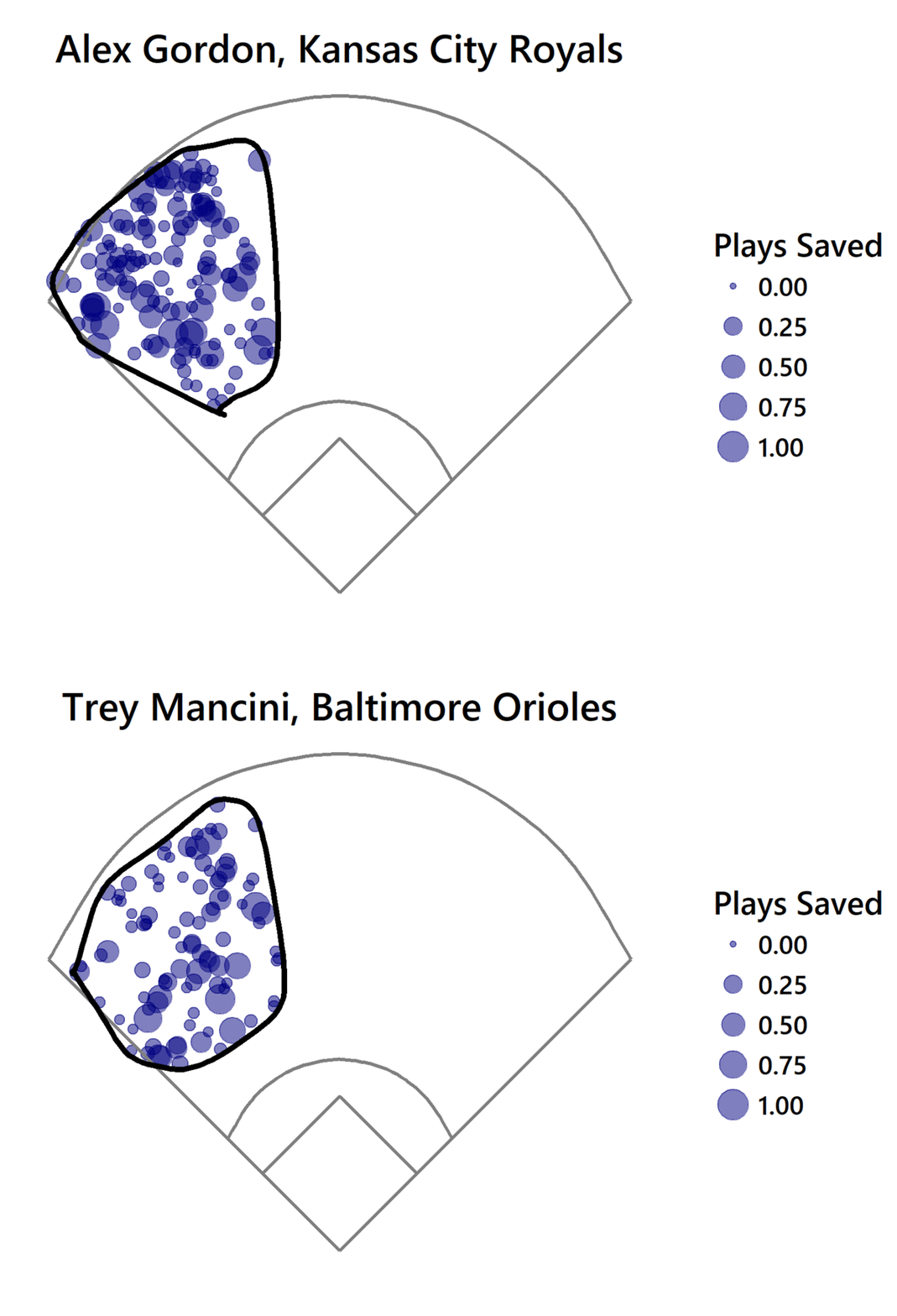
    Fielding Bible Award winners Alex Gordon (LF), Lorenzo Cain (CF), and Mookie Betts (RF) were among the best at their respective positions in 2018 according to Range & Positioning Runs Saved.

    Using BIS’s batted ball location data, let’s visually compare the outfield range of Gordon, Cain, and Betts with other defenders at their positions who did not fare quite as well.

    A few notes on the following graphics…

    • Each point on the plot represents a catch made by the outfielder.
    • The points are sized relative to the “Plays Saved” value for each out. If our system determines a play should be made 60% of the time and the outfielder makes the catch, he gets credit for 0.4 Plays Saved (1-0 minus .6). The better the play, the bigger the scatter point on the plot.
    • Outs with a Plays Saved credit of 0 were removed (meaning 100% expectation of making the catch — “a can of corn” for the outfielder).

    Left Field

    Excellent: Alex Gordon (+10)
    Poor: Trey Mancini (-14)

    LeftField

    Having split time between left field, first base, and DH, Mancini did not have as much volume here, yet he still cost the Orioles 14 runs with his range and positioning in left. The numbers back up what the image shows: Mancini was particularly poor on medium and deep balls (16 plays below average).

    On the other hand, Gordon was excellent en route to his fourth career Fielding Bible Award. The only outfielder with more “Good Fielding Plays” than Gordon this year was Cincinnati’s Billy Hamilton.


    Center Field

    Excellent: Lorenzo Cain (+13)
    Poor: Adam Jones (-19)

    CenterField

    As the image illustrates, Cain was excellent on deep balls — the best among any outfielder, in fact, at +13 plays.

    Jones rated negatively on both shallow and deep balls, while also not exhibiting as much lateral ability as Cain, especially to right-center (possibly a product of defensive positioning).


    Right Field

    Excellent: Mookie Betts (+12)
    Poor: Nicholas Castellanos (-17)

    RightField

    Betts’ dominance reveals itself in the right-center gap. The American League MVP and World Series Champion also did well on deep balls, while still making a bunch of high-quality plays in front of him.

    The image nicely shows Betts’ ability to cover all of right field. He registered +6 on shallow balls, +4 on medium, and +4 on deep. Betts and Adam Duvall were the only outfielders to save at least four plays in all three areas at one position.

    Castellanos appears to have made a decent number of plays going towards the line, but struggled in other areas. He rated particularly poorly on deep balls (17 plays below average).

  • The changes that made Jacob deGrom and Blake Snell Cy Young worthy

    The changes that made Jacob deGrom and Blake Snell Cy Young worthy

    By MARK SIMON

    Pitchers are always making tweaks and adjustments to their deliveries and repertoires in an effort to stay a step ahead of the hitters. In the case of Mets pitcher Jacob deGrom and Rays pitcher Blake Snell, the tweaks made those pitchers Cy Young worthy.

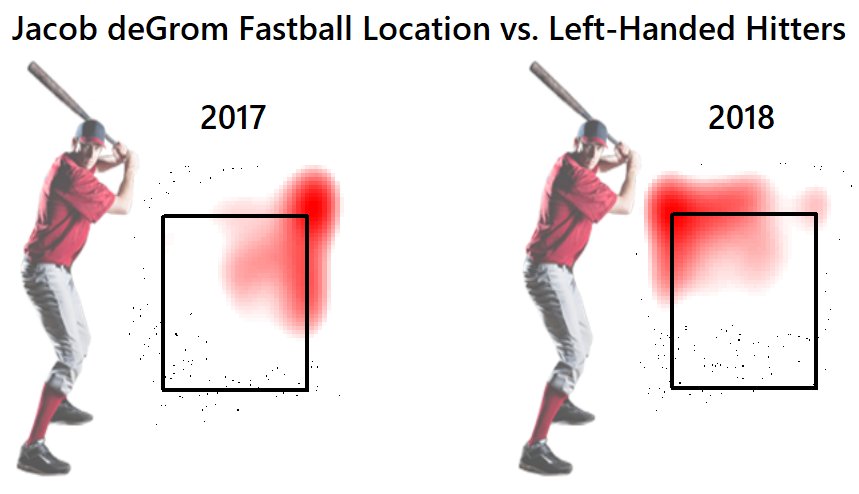
    DeGrom’s big adjustment came by suggestion from pitching coach Dave Eiland, who wanted the Mets pitchers to pitch inside more. For deGrom, this meant completely changing his approach to left-handed batters.

    As my colleague,  Andrew Kyne, noted  earlier this season,  in 2017, deGrom threw only 23 percent of his fastballs inside to left-handed hitters (we’re defining “inside” as on the inner-third of the plate or further inside). In 2018, he more than doubled that to 49 percent, the second-highest percentage in MLB (Kyle Gibson of the Twins was a smidge higher). Here’s what that looks like visually:

    Andrew Kyne/Sports Info Solutions

    DeGrom also upped how often he threw his fastball at the top of the strike zone (or above it) to them, bumping that from 58 percent of pitches to 67 percent. The inside fastballs backed hitters up off the plate. The high heat finished them off. Lefties hit .219/.267/.312 against him in 2018, his best numbers in a season against left-handed hitting. Combine that with even greater dominance against right-handed hitters and deGrom was at the top of his game for almost the entire season.

    DeGrom finished with the second-highest chase rate among pitchers with at least 100 innings pitched (38 percent). He ranked 10th in miss rate (29 percent).

    The pitcher who ranked first in miss rate was Rays pitcher Blake Snell (33 percent). Snell’s breakthrough season was a surprise. He posted ERAs of 3.54 and 4.04 in his first two seasons; you could not have seen his 1.89 ERA coming.

    What hitters apparently had trouble seeing was Snell’s curveball. He threw the pitch about 10 percent of the time in 2017, but netted misses on 51 percent of swings against it. In 2018, Snell’s strategy was to increase his curveball use, cutting back a little bit on his fastball and slider. He doubled his curveball usage to 20 percent of the time. Hitters continued to miss the pitch on more than half of their swings.

    Paired with a 1.5 mile per hour increase in average fastball velocity to nearly 96 MPH, the Rays suddenly had something special. When Snell started on five days rest, those pitches were perfect. In 15 such starts, he pitched to a 1.08 ERA with a 4-to-1 K to BB rate. Three of Snell’s pitches – his fastball, curveball and slider – experienced major jumps in value per FanGraphs’ pitch data. He became a completely different pitcher, one whose performance was suddenly Cy Young worthy.

    Now he and deGrom have trophies to honor the successful changes they made.

    Blake Snell – Curveball Ranks
    Opp BA .126 4th
    Miss Rate 52% 2nd
    Strikeouts 93 7th
    >> Minimum 300 thrown
  • Who were the top performing defensive rookies in 2018?

    Who were the top performing defensive rookies in 2018?

    By MARK SIMON

    Who were the top defensive rookies in 2018?

    No. 1 in the majors isn’t hard to figure out if you’ve been paying close attention this season. We’ve lauded Cardinals outfielder Harrison Bader for his performance throughout the year. He led all rookies with 19 Defensive Runs Saved, only two runs off the overall lead for outfielders.

    Bader didn’t win a Gold Glove, but finished runner-up to Javier Baez for the Multi-Position Fielding Bible Award. He excelled with his range and his hustle in both center and right field. The Cardinals positioned him deeper than others, likely because Bader’s strength is coming in on the ball, which the numbers bore out.

    The next four rookies ranked by Defensive Runs Saved are American Leaguers. In fact, the next two both play for the Kansas City Royals.

    Little went right for the Royals in 2018, but the defensive play of Brett Phillips and Rosell Herrera were bright spots. Phillips was obtained in the trade for Mike Moustakas in late July after playing 15 games (and saving two runs) for the Brewers. Phillips had saved eight runs in a little over 200 innings for the Brewers a year ago. He topped that in 2018, with 10 Defensive Runs Saved in 272 innings for the Royals.

    In all, Phillips has saved 20 runs in only 527 career innings. By comparison, Phillips’ former teammate, Lorenzo Cain, had 20 DRS in 1180 innings this season. Phillips’ strengths are in both his range and his arm. He can come flying in to make a diving catch or go back and rob a home run. He also had six unaided assists (without a cutoff man) as a center fielder the last two seasons, giving him five Runs Saved with his arm. If he can improve on his .187/.252/.306 slash line from 2018, he could be a player to watch and a sleeper candidate to win a Fielding Bible Award in 2019.

    The 26-year-old Herrera was another midseason pickup (off waivers from the Reds in June) whose glove far outvalues his bat. In his debut season, he saved 10 runs in more than 500 innings, with those runs split almost entirely between second base and right field. (He cost his team three runs in five games at third base.) He was well-positioned at second, allowing him to make a few plays in the first base-second base hole that others wouldn’t. His time in right field included robbing a home run from Alex Bregman, one of a few balls hit to the deepest part of the ballpark that were well-handled by Herrera.

    Another player in a similar mold is Angels infielder David Fletcher, who totaled eight DRS, primarily split between second base and third base. He had solid range ratings at both second and third base and was strong in turning the double play at second, converting 32 of 39 opportunities (82 percent – MLB average is 66 percent). Fletcher’s greatest strength at third base was in fielding balls hit down the line, ranking tied for fourth best at converting balls hit there into outs.

    Two other players warrant special mention. Rangers utility man Isiah Kiner-Falefa came to the majors with a well-polished defensive game. That was evident when he was at third base and second base, where he totaled nine DRS in a little more than 500 innings.

    But Kiner-Falefa doesn’t show up on the leaderboard because of his troubles playing catcher. In just over 300 innings, he cost the Rangers seven runs with framing and three runs with pitch blocking. If Kiner-Falefa mans the hot corner or second base regularly in 2019, you’ll probably see and hear more from him.

    Another is Joey Wendle, who finished with five Defensive Runs Saved, but was invaluable in the Rays’ frequent shifting, which isn’t a part of the basic Runs Saved calculation for players. As we documented at The Athletic earlier this season, Wendle’s skill at making throws from any angle made him a potent performer in the field, whether he was playing at second, shortstop, third or left field. He finished third in our Multi-Position voting for the Fielding Bible Awards. With Wendle at second and Kevin Kiermaier in center field, the Rays have a great up-the-middle defensive foundation moving forward.

    Among the Rookie of the Year candidates, Braves outfielderRonald Acuña Jr. finished with four DRS, though he finished at -2 in his primary position, left field. The issue with Acuna wasn’t range and positioning (he totaled six Runs Saved at that), but his arm, which cost his team three runs due to his poor rate of deterring baserunner advancement.

    Nationals outfielder Juan Soto saved two runs with his arm, but made many other mistakes throughout the season. He cost his team five runs in the field.

    In the AL, Yankees infielder Gleyber Torres had good early-season numbers, but ended up costing his team a run in non-shift situations (we note that because his performance was strong in shifts, which don’t count within Defensive Runs Saved). If Miguel Andujar wins Rookie of the Year, it will be in spite of his defense. His -25 DRS were the worst of any infielder. Angels P/DH Shohei Ohtani graded league-average in his 10 games as a pitcher, as did Dodgers starter Walker Buehler.

  • Open the Handbook and let the numbers tell the story

    Open the Handbook and let the numbers tell the story

    By MARK SIMON
    You can purchase the 2019 Bill James Baseball Handbook here

    The Bill James Handbook is 622 pages of baseball goodness. It’s easy for me to say that – I was one of many who worked on it at the end of the regular season and through the beginning of the postseason. But as a full-fledged baseball nerd, it’s a lot of fun to poke around on random pages looking for stories within the numbers.

    Here are a few that I liked:

    Page 78: Mariners didn’t make postseason, but surpassed expectations
    The Mariners won 89 games, but were expected to win only 77 by Pythagorean expectation. They exceeded their expectation by the largest amount, 12 wins. On the other side, the Dodgers were expected to win 103 games and won 92. They finished the most beneath their Pythagorean expectation (11 wins).

    Page 388: Billy Hamilton wins every footrace
    Billy Hamilton had the fastest average time on attempts to steal second base this season, 3.39 seconds on 27 timed attempts. That just edged out Adalberto Mondesi of the Royals (3.41), Mallex Smith of the Rays (3.42), Jarrod Dyson of the Diamondbacks (3.42) and Dee Gordon of the Mariners (3.43).

    Page 425: Palka king of avoiding flyouts, hitting homers
    White Sox outfielder Daniel Palka hit 22 long fly outs and 27 home runs. How do we define a long fly out? You’ll have to read the book! But we can tell you that Palka was the only player with at least 20 home runs who had more home runs than long fly outs (Shohei Ohtani and Aaron Judge came close).

    Page 443: ‘Shark’ bitten
    Oh how the decent pitchers have fallen. Giants pitcher Jeff Samardzija had more 1-0 counts (93) than 0-1 counts (89) in 2018. That’s a sharp drop for a pitcher who typically has strikeout-to-walk ratios in the 3s or higher. A check of Baseball-Reference shows that after 1-0 counts, opponents hit .310/.462/.535 against Samardzija last season. Yikes!

    Page 561: Royals rule replay
    The most successful team with instant replay was the Royals, who had 33 of 42 challenged calls overturned, a 79 percent success rate. The Royals were second-best in 2017, successful on 71 percent of challenges.

    The least successful challengers in 2018 were the Brewers, who were successful on 7-of-34 (21 percent).

    Pages 594-595: Milestone watch
    Per Bill James’ The Favorite Toy methodology, Edwin Encarnacion has a 54 percent chance to hit 500 home runs. Nick Markakis has a 41 percent chance to reach 3,000 hits and Nolan Arenado has a 15 percent chance at 2,000 RBI, within striking distance of Hank Aaron’s record 2,297. Those are three names I wouldn’t have expected to have those sorts of chances at those kinds of milestones.

  • 2019 Bill James Baseball Handbook: “Shift Update”

    2019 Bill James Baseball Handbook: “Shift Update”

    This is an excerpt from the 2019 Bill James Baseball Handbook. You can purchase it online here.

    By JOHN DEWAN
    Reports of the demise of The Shift are greatly exaggerated.

    Last year we reported on these pages that the number of shifts employed by Major League Baseball teams declined for the first time after five straight years of increases between the low of a 34% increase in 2015 and 93% increase in 2014.

    Not no more.

    Shift usage resumed its mercurial rise once again in 2018. Nearly 35,000* shifts were employed, an increase of 30% from 2017.

    Twenty-five of the 30 teams in baseball increased their shift usage. One of the five who decreased was the Brewers, and they still ranked fifth in overall shift usage.

    And more importantly, shift effectiveness exploded off the charts. Using the new technique developed by Baseball Info Solutions to evaluate shifts by comparing them to non-shift alignments, the number of runs saved per 100 shifts was at an all-time high in 2018 at 1.71 runs saved per 100 shifts:

    And yet, there is room for more! I expect to see 40,000 in 2019.

    As noted in the August 30th edition of Stat of the Week.

    While teams are shifting more than ever, there are still improvements that can be made. SIS’s BIS-D software provides a recommendation for every player in MLB as to whether that player is a shift candidate or not, and about one-third of shifts this season have been against players for whom the software recommends playing a standard defense. There have also been about 18,000 balls in play where the defense did not shift when the system suggested one.

    How has the shift impacted the performance of those who get shifted? On the whole, the shift lowered shift candidates’ batting average on grounders and short line drives (BAGSL) by 23 points, while it had the opposite effect against all other batters, raising their BAGSL by 4 points.

    *The averages are weighted such that players with extreme shift tendencies (high or low) are not overrepresented, thus separating the effect of the shift from batter quality.

    With shifts comprising a larger percentage of balls in play than ever before, it’s never been more important to make sure that the correct batters are being shifted.

    Some additional observations (compliments of Baseball Info Solutions’ Mark Simon):

    • The Royals, Phillies, Tigers, Mets, Cardinals doubled their shift usage from 2017 (the Cardinals still have a long way to go). Three of those five teams (Phillies, Tigers, Mets) had a new manager in 2018, while the Cardinals changed theirs mid-season.

    • The Twins’ usage almost doubled. They ended up third in MLB in usage.

    • The Diamondbacks led the majors in Shift Runs Saved (39). They ranked eighth in shift usage.

    • When the A’s shifted, it worked really well. They ranked 25th in shift usage but second in Shift Runs Saved.

    • The Tigers are a good example of how a shift can help an infield. Their infield combined for -14 runs saved in non-shift situations, but 31 in shift situations.

    • The Yankees are another good example—their infield combined for -40 runs saved in non-shifts and 20 runs saved in shifts

    • The Red Sox infield, too—it was at -60 runs saved, but they had 16 runs saved in shifts

    • Four of the top six teams in shift usage won at least 90 games this season (Rays, Astros, Brewers, Yankees)

    • Remember last season when the Rockies drastically reduced their shift usage? They raised it by 56% this season.

    • Mickey Callaway’s increased shift usage may have helped Jacob deGrom. The Mets converted 56 of 65 ground balls and bunt grounders into outs when shifting with deGrom pitching. That 86% out rate in the shift ranked second in MLB to Zack Greinke (also 86%).

    • Seven teams saved at least 20 runs with the shift this season. Only three did so in 2017.

    Finally, here is a team-by-team look at how often they are shifting, plus the list of the top 30 shifted batters and how they performed against the shift in 2018.

  • The many multi-position standouts of 2018

    The many multi-position standouts of 2018

    Tigers outfielder JaCoby Jones had the most Defensive Runs Saved of any outfielder in the majors this season.

    But he did not win a Fielding Bible Award, nor will he win a Gold Glove, as he was not among the finalists named at the position in which he was eligible, left field.

    Jones actually played more innings in center field this season (that’s where he was Fielding Bible eligible), but at the time of his team’s 138th game (Rawlings’ standard), he had played more games in left. Regardless, he didn’t win in either spot. He was the most notable of a few players who were multi-positional standouts and finished behind Javier Baez in the Fielding Bible Awards, but merit more than a passing mention for their 2018 contributions.

    Jones saved 21 runs—11 in 452 innings in left field and 10 in 558 innings in center field. He ranked fourth at the former position and seventh at the latter position. He’s one of five players to record at least 10 Defensive Runs Saved at two positions in the same season since Baseball Info Solutions began calculating the stat in 2003. The others are Alex Rios (2008 CF and RF), Ben Zobrist (2009 2B and RF), Nyjer Morgan (2009 CF and LF) and Ender Inciarte (2015 LF and RF).

    Jones’ 21 Defensive Runs Saved rank second for a season among Tigers outfielders in the DRS era, trailing only Austin Jackson’s 26 in 2011.

    What made Jones great depended on where he played. In left field, he fared better on balls hit to the shallowest part of the outfield. In center, he provided more value in tracking down balls hit to the deepest part of the ballpark.

    Jones was boosted by a pair of home run robberies (one shy of Adam Engel for the MLB lead). They were two of his 15 jumping catches, tied with Kevin Kiermaier for second among outfielders. Only Billy Hamilton of the Reds had more with 18.

    Harrison Bader of the Cardinals was in a similar position to Jones in that he split his time between two outfield spots – center field and right field – and excelled at each. But not playing enough at either one may have hurt him when it came to consideration.

    Bader saved 11 runs in 615 innings in center field and eight runs in 270 innings in right. He was very good at tracking down balls hit to both the shallowest and deepest parts of the ballpark at each spot. His 72 sprinting catches ranked second among outfielders behind Inciarte’s 77. (Per Statcast, Bader’s 29.9 feet per second sprint speed ranked eighth among those whose speed was measured at least 25 times.) His nine diving catches tied for fourth.

    Among infielders, Miguel Rojas’ season of 14 Runs Saved with the Marlins should not be forgotten. Rojas saved 10 runs in 657 innings at shortstop and four runs in 285 innings at third base. He also saved one run in 102 innings at first base, though lost one run in 68 innings at second base.

    What was most impressive about Rojas’ play at shortstop was his range (he had positive ratings on getting outs on balls hit up the middle and in the hole) and his avoidance of mistakes. He finished with 22 Good Fielding Plays and 13 Misplays & Errors there, as charted by BIS Video Scouts. (Good Plays are often Web Gem-caliber plays; Misplays are plays that have a negative consequence, such as costing the opportunity for an out.) Rojas’ ratio of 1.7 Good Plays to Misplays/Errors was the best among shortstops last season.

    Another infield standout was Joey Wendle of the Rays. Wendle played at least 60 innings at four positions last season. At second base, his primary spot, Wendle saved five runs, with much of that coming through making nice plays on balls hit in the first base-second base hole. He added more value there through his performance in the many Rays’ defensive shifts (which are not counted in the basic Runs Saved computation). He also chipped in a run in a little more than 150 innings at third base.

    Jones, Bader, Rojas and Wendle don’t have any hardware to commemorate their work. But they’re worthy of remembering when we think about the year in defensive excellence.

  • Which catchers are best at stealing strikes?

    Which catchers are best at stealing strikes?

    BY MARK SIMON
    With there being an off day in the World Series, let’s take a look at a leaderboard that stoked our interest this season –- which catchers did the best job of getting strikes on pitches that maybe he shouldn’t have gotten strikes on?

    Our definition for this was to look at the percentage of pitches that were called strikes, and were outside the strike zone, but within two inches of an edge of the strike zone (as designed by my colleague, Andrew Kyne). This was measured per charting from BIS video scouts. This is an inexact science based on many things (and publicly available pitch-location data assisted the process), but we’re comfortable with our methods and our video scouts.

    Here are the top 5.

    1. Jeff Mathis, Diamondbacks (22.1%) –- Mathis was the head of the Diamondbacks three-pronged catcher platoon. Each of the others made the top 10 too, but Mathis was the best of the best. He was of major assistance to Zack Greinke, having caught all of Greinke’s starts. Mathis’ long-worked skill of getting strike calls on low pitches also helped coax a career year from Patrick Corbin, who had a 1.83 ERA in 12 starts with Mathis as his backstop.

    2. Austin Barnes, Dodgers (21.4%) –- You might have thought Yasmani Grandal would be the top Dodger, but it’s actually Barnes, who doesn’t hit much, but brings great value to the pitching staff. His success rate jumped three percentage points, meaning he produced about 50 more stolen strikes than he would have at least season’s 18.3 percent rate.

    3. Gary Sanchez, Yankees (19.8%) — Sanchez’s pitch-blocking skills are much maligned, but his pitch framing compensates successfully for that.

    Take a look at Sanchez’s called strike rates by location in this chart, paying specific attention to the areas with multiple asterisks. Sanchez was excellent at getting extra strikes in all three of those areas. From top to bottom (with the asterisks), he’s 7, 14 and 10 percentage points above the MLB average. And that’s just for left-handed hitters.

    4) Alex Avila, Diamondbacks (19.8%) — Avila has had his ups and downs with his framing success, but in 2018, he followed Mathis’ lead and was quite good, particularly with pitches that were just off the outside corner to right-handed batters and the inside corner to left-handed batters. It helped him finish with a career-high six Defensive Runs Saved.

    5. Max Stassi, Astros; Luke Maile, Blue Jays, Chris Iannetta, Rockies (19.7%) — There is not a huge difference between the fifth-best and 10th-best catchers on this list. These three just happened to be in the next three spots. Stassi put a lot of effort into improving his framing in the offseason and it paid off. Maile’s pitch-framing was good in the past. This year was more noteworthy for his bat catching up to his glove. Iannetta, like Avila, has had good seasons and bad seasons. This year, he was good at stealing strikes, but didn’t rate as well on pitches in the strike zone.

    Let’s note one more name since it’s pertinent to the World Series.

    11. Sandy Leon, Red Sox (18.9%) — Leon is a good strike-stealer (11th rates in the top 20% of catchers), but his forte is in making sure that strikes are strikes. He has the highest called strike rate among catchers on pitches in the strike zone, at nearly 94 percent.

    And let’s also note the catcher who rates at the bottom of the list.

    65. Isiah Kiner-Falefa (13.1%) — The Rangers put Kiner-Falefa in a challenging spot, asking him to catch a little more than 300 innings this season. The rookie utility man who is a standout defensive third baseman, he struggled both with framing and pitch-blocking, costing his team 10 runs in total in those two areas.